
Businesses have a significant impact on our land, waterways, and even the air we breathe. Fortunately, today, they actively pursue environmental sustainability as part of their societal duty.
Although the law requires environmental compliance, it also offers new opportunities that make good business sense. Caring for the planet forms part of a company’s ethical obligation, known as corporate social responsibility (CSR).
What Is Corporate Social Responsibility?
CSR is the concept that all businesses are accountable not just to stakeholders but to society. They must recognize and fulfill their duty of care to the environment and the public. While organizations set up CSR frameworks in various ways, they generally adhere to the guiding principle of contributing positively to the world.
Corporate social responsibility acknowledges that a company’s performance cannot be measured by profit alone but relies on its social and environmental impacts. The modern interpretation of CSR took hold during the 1960s when movements for labor rights, racial equality, and environmental protection took center stage. Today, many organizations frame CSR using the triple bottom line, known as the “three Ps”: profit, people, and the planet.
Companies use CSR to self-regulate, define values, and positively impact the world. Companies often have dedicated teams to strategize various action plans, celebrate and measure successes, and share these efforts with their inside and outside people through CSR reports.
The Four Tenets of Corporate Social Responsibility
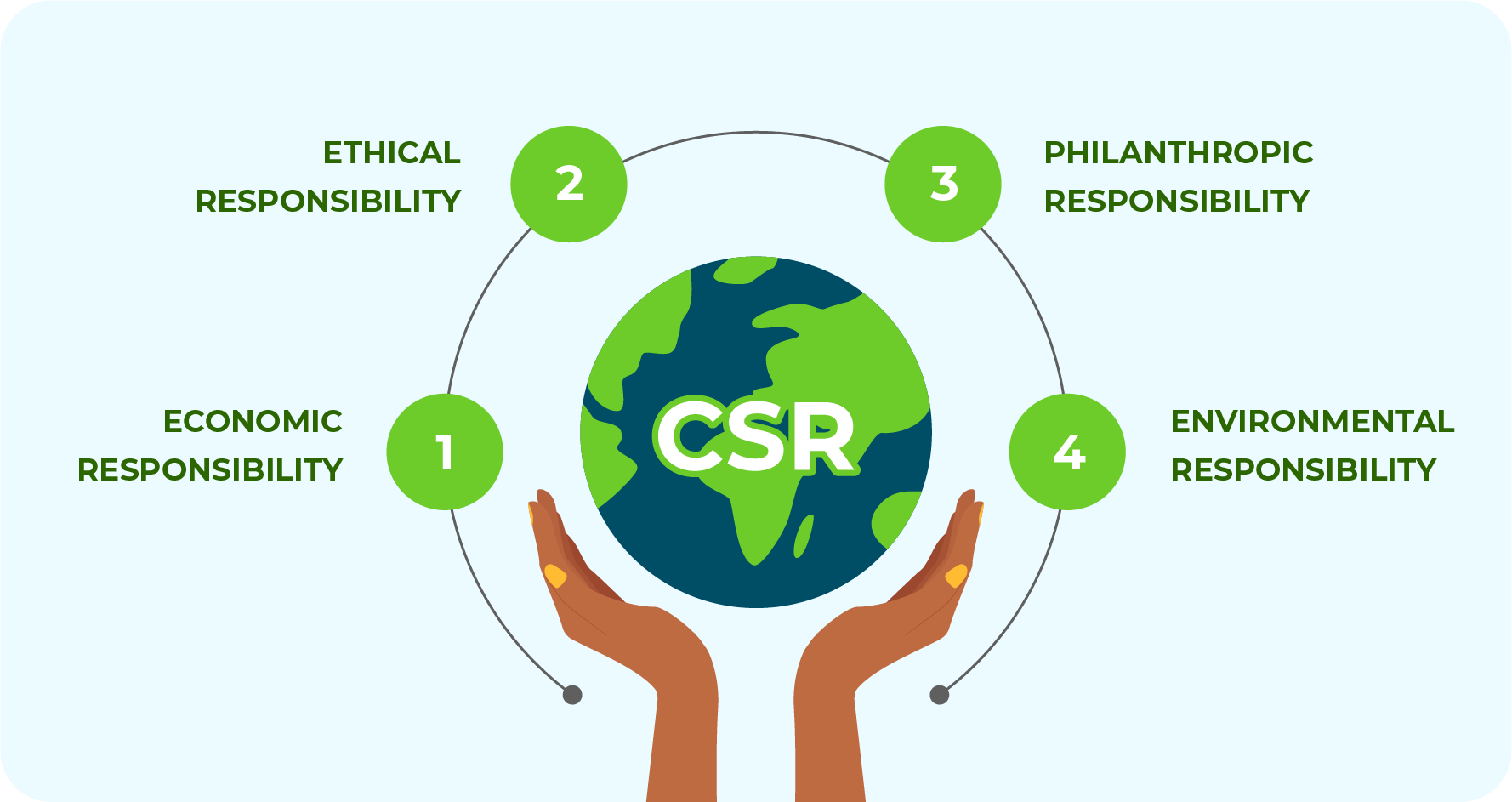
A robust CSR strategy considers its own finances, the good of the people, the duty to give back, and the planet’s health. Together, these four priorities serve as a guide to help corporations navigate their societal obligations.
The four tenets of CSR include:
- Economic responsibility: Success isn't just about making the most profit. Economic responsibility means businesses must stand by their financial choices.
- Ethical responsibility: Ethical responsibility is the company's basic obligation to do no harm and practice fair treatment for all. For example, a business might set its minimum pay higher than the state minimum wage or offer extended maternity and paternity leave.
- Philanthropic responsibility: Philanthropy is a vital aspect of CSR. Philanthropic organizations may dedicate some earnings to corporate donations, volunteer efforts, or community drives. Others may create charitable trusts or foundations to give back to society or do good in the community.
- Environmental responsibility: Previously, companies treated their environmental consequences as an afterthought—if it was considered at all. Fortunately, there has been big changes in the evolution of corporate sustainability. Environmental responsibility now involves stewardship initiatives and meeting EPA standards for waste management.
Corporate Social Responsibility and the Environment
Many businesses, regardless of size, leave a significant carbon footprint. In addition to shipping and greenhouse gases, companies often release harmful pollutants and use many natural resources. Reducing this footprint benefits both society and the company.
Companies looking to improve their environmental impact can do so in several ways:
Circularity
A circular economy reduces waste by implementing familiar principles such as reduce, reuse, and recycle. Additionally, it encourages practices such as renting equipment instead of owning and repairing instead of discarding damaged items. This approach transforms production into a closed-loop system, preventing old or unwanted products from ending in landfills.
Reducing Pollution
Industrial products often contain harmful chemicals or release them during manufacturing. Responsible companies are finding new ways to eliminate toxic substances from entering the air, water, and soil, contributing to a safer and cleaner environment. For example, textile companies may switch to non-toxic dyes, and restaurants may invest in biodegradable cutlery.
Cradle-to-Cradle Design
One concept of a circular framework involves breaking products down into their fundamental elements to minimize waste at every stage. For instance, the metals and minerals from a discarded cell phone can be extracted for reuse, preventing them from ending up in e-waste landfills and causing harm to workers and local communities. Likewise, biological materials like food or natural fabrics can be transformed into compost to generate new raw materials.
Mitigating Climate Change
Certain businesses strongly focus on actively reducing the greenhouse gas emissions causing climate change. They achieve this by curbing energy consumption, adopting clean energy sources, or offsetting their emissions through carbon credits. These methods can entail capturing and reusing carbon or methane, installing solar panels, or renovating offices and manufacturing facilities to reduce energy usage. Additionally, efforts may involve innovating more energy-efficient manufacturing methods and decreasing emissions associated with shipping and transportation.
Offsetting Negative Impacts
In cases where negative impacts are unavoidable, companies can mitigate the effects of their practices by planting trees, funding research, or increasing their use of renewable resources. For instance, auto manufacturers may develop a range of electric vehicles and e-bikes or install solar panels on company land.
Land and Biodiversity Conservation
Businesses leave a significant ecological footprint by sourcing raw materials, transporting goods, or just through the locations of their facilities. To counter these impacts, companies can fund sustainable development projects to restore or safeguard biodiversity.
Conservation initiatives may involve Indigenous-led land management practices or cleaning up and restoring ecosystems in previously affected areas, like former mines. Other approaches focus on co-existence, like implementing regenerative silvopasture to combine crops, livestock, and trees in ways that safeguard biodiversity and natural resources.
What are the Benefits of Corporate Social Responsibility for Businesses and the Environment?
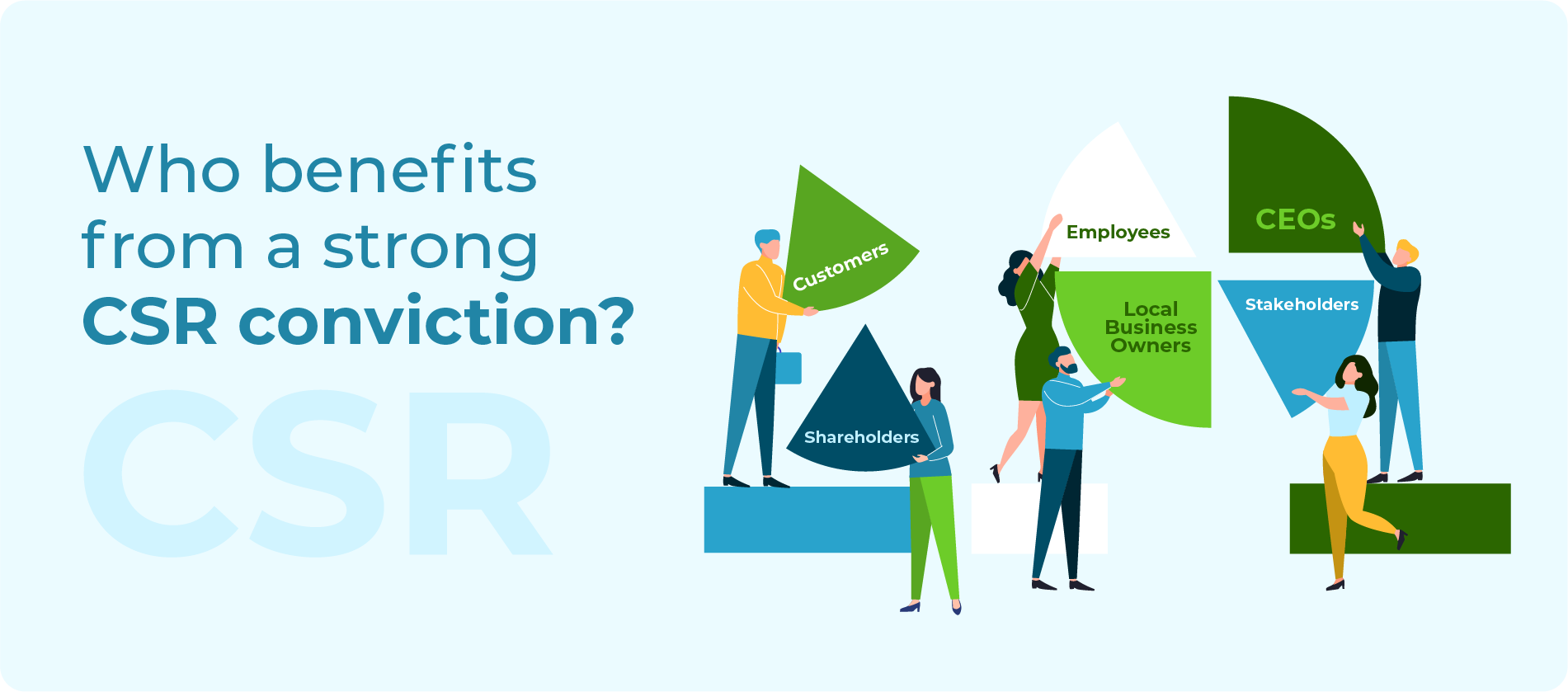
Commitment to CSR can lead to competitive advantages and significant social impact. Many parties benefit from a strong CSR conviction, including:
Customers
Public perception greatly influences a company's success, making it crucial to demonstrate your business as a force for good. Actively supporting and promoting socially important causes is an effective strategy to maintain a strong market presence. CSR initiatives can also serve as potent marketing tools, enabling you to improve customers’ perception of your brand and establish a positive reputation with regulators.
Shareholders
Shareholders are increasingly focusing on a company's commitment to social responsibility. A strong dedication to CSR sends a clear message to investors and partners that the company is concerned with both short-term and long-term success. Your CSR intertwines closely with ESG metrics, which allow external analysts to measure a company's social initiatives—a significant factor influencing investors' decisions to maintain their interest in a company.
Employees
Implementing CSR initiatives naturally compels business leaders to scrutinize their hiring and management methods. Additionally, these initiatives have the potential to enhance employee engagement and workplace satisfaction, which are essential factors in retaining talent. The workforce is a vital part of a company and plays a crucial role in implementing CSR initiatives aligning the company’s values with those of its employees. As a result, CSR initiatives can even draw in prospective employees who share the same strong personal values as the organization. Today, a well-defined sustainability strategy plays a significant role when the most sought-after talent decides to build their careers.
Local Business Owners
Some initiatives don’t just benefit the planet; they have a significant impact on the community surrounding the business. For example, restaurants that use local sourcing for their ingredients might create funds to help local suppliers and encourage farming efforts. These funds help farms expand and strengthen the local supply chain. Ideally, as the company continues to grow, the local economy grows alongside it.
CEOs
Implementing lean initiatives, such as reducing packaging and energy consumption, can effectively cut production costs. Moreover, businesses have the leverage to encourage their supply chain partners to adopt more sustainable practices, further bolstering their financial outlook.
Stakeholders
Tying executive compensation to ESG goals, creating dedicated development funds, and re-investing excess capital into building the company's future signals a resilient business strategy.
What Are the Biggest Hurdles to Achieving Corporate Social Responsibility?
Corporate efforts to minimize unethical and environmentally harmful practices are commendable, but sometimes, the intention fails to produce tangible results. Unfortunately, not all businesses implement comprehensive, systemic changes.
Common ineffective sustainability policies include:
- Greenwashing: Climate-damaging industries (such as oil companies) rely on greenwashing to appear more environmentally friendly than they actually are.
- Telling half the story: Fast fashion outlets may boast about their sustainability portfolios while continuing to produce disposable and resource-intensive clothing.
- Shifting the burden: Environmental initiatives can have unintended negative impacts, such as redirecting waste into low-income or marginalized communities.
- Playing catchup: One significant hurdle to sustainability is establishing efficient and scalable infrastructure to carry out cradle-to-cradle processes.
- Ineffective reporting: Many third parties offer sustainability certification schemes, but their accuracy and reporting efforts can vary.
How Can We Implement Effective Policies to Uphold Our Corporate Social Responsibility?
There are myriad ways to implement CSR strategies depending on your business location and industry. Incorporating CSR initiatives into your business operations ensures that your company's ethical values are reflected in its daily activities and decision-making processes. Regardless of who you are and what you do, it’s crucial to communicate your goals and achievements openly. Any CSR decisions made behind closed doors can raise suspicions about ulterior motives and the actual impact of your contributions.
First, engage your employees in the decision-making process. Form an internal team to spearhead these efforts and identify organizations relevant to your business or causes meaningful to your staff. Involving your employees not only boosts engagement and the likelihood of success but also brings transparency and confidence to your team.
You should also keep your customers informed about your social responsibility efforts. Consumers are increasingly inclined to choose sustainable products over conventional alternatives, and they deserve to share in the sense of fulfillment that comes with making the right choices.
Finally, it's wise to proactively share your efforts with investors rather than waiting for them to request social impact data. You can disclose your ESG scores, sustainability reports, and CSR metrics, demonstrating your commitment to responsible business practices.
Environmental Initiatives to Help You Meet Your Corporate Social Responsibility Goals
Reflecting on CSR often leads to innovative and groundbreaking solutions that benefit companies, the climate, and consumers. For example, reexamining their waste management process can help businesses consume less energy and reduce their landfill contributions. This strategy is environmentally friendly, reduces your energy and materials costs, and improves your ESG scores.
At Waste Harmonics Keter, we specialize in helping businesses implement effective waste management processes that are not only environmentally friendly but also cost-effective and efficient. Our end-to-end waste management systems reclaim money and energy, while our thorough ESG reporting keeps you informed and on track with your CSR goals.
Interested in learning more? Talk with a real person from our team.