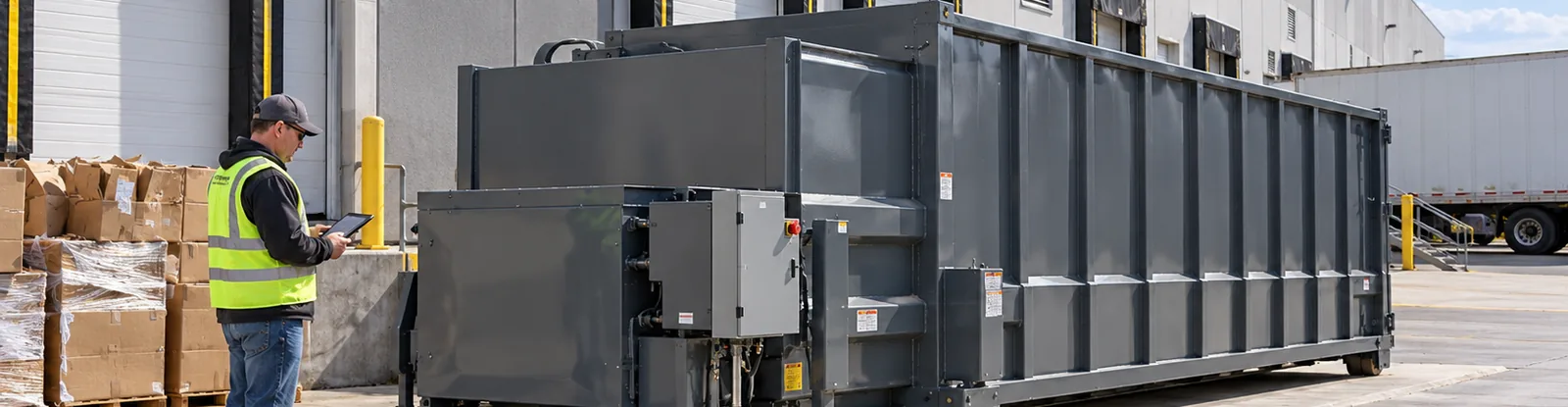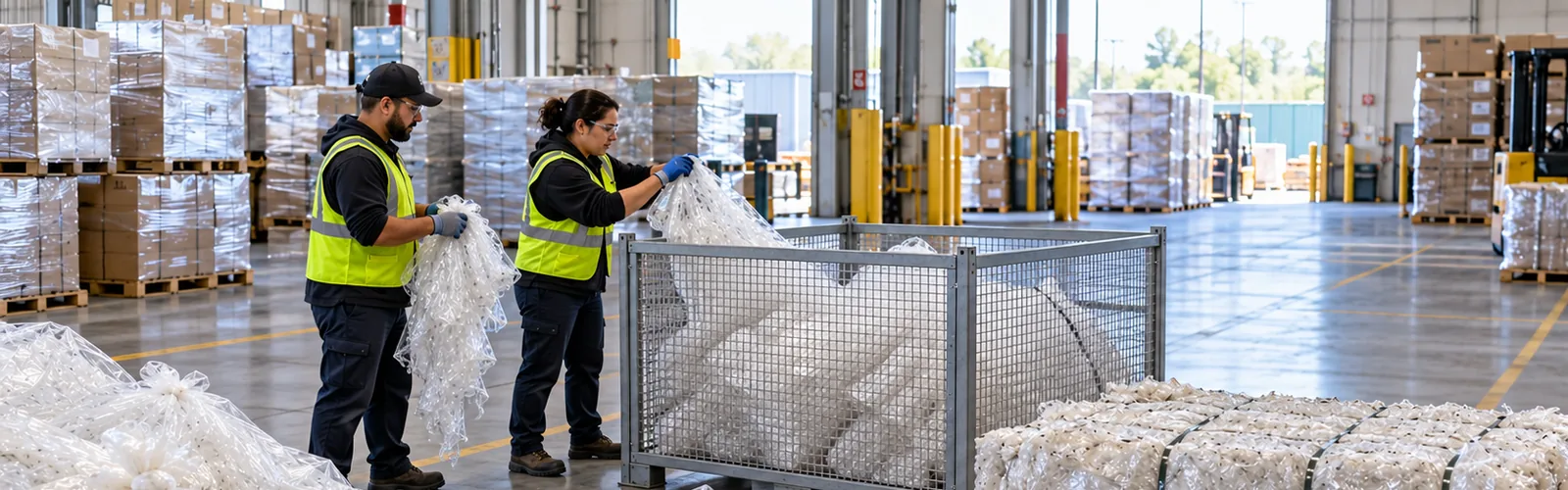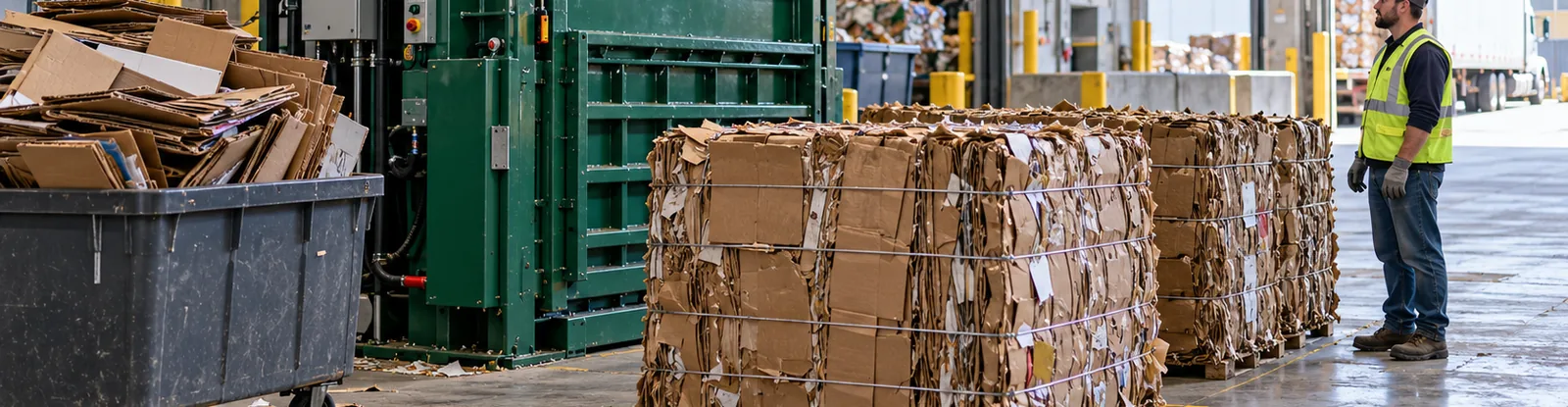
Flattened boxes drifting across a dock. A corner stack that has become a fire-code conversation. Someone feeding another armful into the compactor because it is the closest opening.
That last habit is the expensive one. For a high-volume warehouse, distribution center or multi-site retail backroom, cardboard is usually the single largest recoverable stream on site, and how it leaves the building decides whether it shows up in the budget as a cost or a credit. For operations and finance leadership, a cardboard baler is less an equipment decision than a question about which column the material lands in.
Why Baled Cardboard Is Worth Money
Old corrugated containers are among the most heavily traded recovered paper grades in the world, because containerboard mills want them as feedstock. A mill is buying a raw material, and like any raw material it has a specification.
Cardboard thrown into a compactor fails that specification instantly. It is wet, it is mixed with food waste and film, and nobody can tell what is in the bale. You paid for the packaging once when it arrived, and you pay again to throw it away. A baler interrupts that by keeping the material separate, dry and identifiable.
The honest trade-off, stated plainly, is that rebate value is real but it is not a guarantee. Commodity markets move, and what a bale earns in one market may differ in another. The economics of baling should be built on the avoided disposal cost first, with rebate as upside rather than the whole case.
Grade Is the Whole Economic Argument
This is the part most baler content skips, and it is the part that determines what you get paid. Recovered paper trades against published grade specifications, and the tolerances are tighter than people expect.
Under the ReMA scrap specifications, standard Grade 11 Corrugated Containers permits prohibitives up to 1% and total outthrows up to 5%. Grade 12, Double-Sorted Corrugated (sourced from supermarkets or industrial and commercial facilities and sorted to exclude boxboard, offshore corrugated, plastic and wax), cuts that to 0.5% prohibitives and 2% outthrows. The tighter grade is the better-paying one.
Wax is the recurring problem. Some mills treat waxed containers as outthrows and others treat them as prohibitives, so acceptance is decided mill by mill. For any facility receiving waxed produce boxes, that is worth establishing with the buyer before the bales start moving, not after a load is downgraded.
Vertical or Horizontal, Match the Volume
The machine choice follows throughput. Everything else (footprint, labor, bale weight) follows from that.
| Consideration | Vertical Baler | Horizontal Baler |
|---|---|---|
| Suited to | Retail backrooms, smaller DCs, moderate daily volume | High-volume DCs, fulfillment centers, manufacturing |
| Loading | Manual, front-fed by an operator | Conveyor or hopper fed, can run semi-automatically |
| Labor per bale | Operator attends each cycle and ties off the bale | Minimal operator attention during the run |
| Footprint | Small floor area, needs vertical clearance | Substantial floor area and a dedicated area |
| Bale weight | Lighter bales; more bales per truckload | Heavier, mill-standard bales |
| Capital profile | Lower cost, quicker to justify at modest volume | Higher cost, justified by throughput and labor saved |
The mistake is buying a horizontal baler for a site that cannot feed it. An underfed horizontal unit is capital standing still. The opposite mistake is quieter and more common, which is running a vertical baler at a volume that has quietly doubled, so that an operator now spends a meaningful part of every shift tying bales.
What a Cardboard Baler Changes on the Dock
The commodity argument is the headline, but the operational benefits are what facilities teams actually feel.
- Floor space comes back. Loose OCC is mostly air. Baled, the same material occupies a fraction of the footprint and stacks predictably rather than sprawling toward the door.
- Fire-code exposure drops. Stacked loose cardboard against a wall or near an exit is a recurring inspection finding. Bales in a designated area are a managed material.
- Hauls get displaced. Cardboard removed from the general waste stream is volume that no longer fills the compactor, which changes pull frequency on the disposal side as well.
- Housekeeping stops being a daily argument. A defined destination for cardboard is the thing that makes the backroom stay tidy, far more than instruction does.
The Costs Nobody Puts in the Business Case
A fair case includes the parts that are easy to leave out.
- Labor per cycle. On a vertical unit, somebody is tying bales. That time is real and it falls during the shift, not outside it.
- Bale storage and handling. Bales need somewhere dry to wait, and something to move them. Wet bales lose grade and can be rejected.
- Baling wire and consumables. Small per-bale cost, but continuous, and it belongs in the model.
- Contamination discipline. The whole economic argument rests on a clean stream. One habit of tossing film or food packaging into the baler can move a load from Grade 12 to Grade 11, or out of spec entirely.
- Maintenance. Hydraulic equipment on a dock needs scheduled attention, and that obligation sits with somebody.
Who Can Legally Operate a Baler
This constrains staffing in a way that surprises retail operators in particular. Under 29 CFR 570.63, operating or assisting to operate a scrap paper baler is a prohibited occupation for employees under 18, and so is setting up, adjusting, repairing, oiling or cleaning one.
Employees aged 16 and 17 may load a baler but not operate or unload it, and only where the equipment meets the applicable ANSI Z245.5 standard, the machine has a key-controlled on-off switch operated by someone 18 or older, and a notice stating the restriction is posted on the machine itself. Clearing a jam counts as operating. If your backroom runs on a young workforce, this decides who can be on the dock.
From Baler to Mill, Waste Harmonics Keter Manages Everything
Waste Harmonics Keter rents balers and compactors rather than selling them, new or reconditioned, with freight, installation and the enclosure handled, and preventative maintenance and repairs managed within the program. The customer supplies site access, power and the pad. That structure keeps capital out of equipment that generates no revenue on its own.
On the commodity side, recycling and diversion covers the part that actually determines the return, namely site-level waste composition analysis to raise capture and cut contamination, program design including containers and signage, and routing to vetted recyclers with documented, site-level diversion data rather than vendor estimates. Preparation to maximize rebate eligibility is part of that where markets allow, though rebate value varies by market and is not guaranteed. Stream-specific detail sits on the cardboard and OCC page, and equipment detail on equipment and compactor services.
Stop Paying to Throw Away an Asset
If cardboard is going into your compactor, you are paying to dispose of a material a mill would buy. A cardboard baler is worth having when your OCC volume can keep it fed and your operation can keep the stream clean enough to hold a grade. Those two conditions, not the machine's price, decide the return.
Frequently Asked Questions
How much cardboard volume justifies a cardboard baler?
There is no universal threshold, because it depends on your per-pull disposal rate and local rebate market. The useful calculation is avoided hauls first. Work out how much compactor volume the cardboard currently occupies and what removing it does to pull frequency. If that alone approaches the cost of the machine, rebate becomes upside rather than the justification.
What contaminants cost us the most at the mill?
Prohibitives (material that cannot be processed or that damages equipment) are capped at 1% for standard Grade 11 and 0.5% for Double-Sorted Grade 12. Plastic film, wet strength board and waxed corrugated are the usual offenders in a warehouse stream. Wax is treated differently by different mills, so confirm your buyer's position before you bale it.
Can bales be stored outside?
Not well. Moisture is the main enemy of a bale's value, since wet material loses grade and can be rejected outright on arrival. Bales need a dry, covered area and a clear rotation so that older bales move first rather than sitting through a season.
Does a baler replace the compactor?
No. It takes one stream out of it. Most facilities run both. The baler handles OCC as a recoverable commodity, the compactor handles what is genuinely waste. Removing cardboard usually changes the sizing and pull frequency on the compactor side, which is worth re-checking once baling is established.