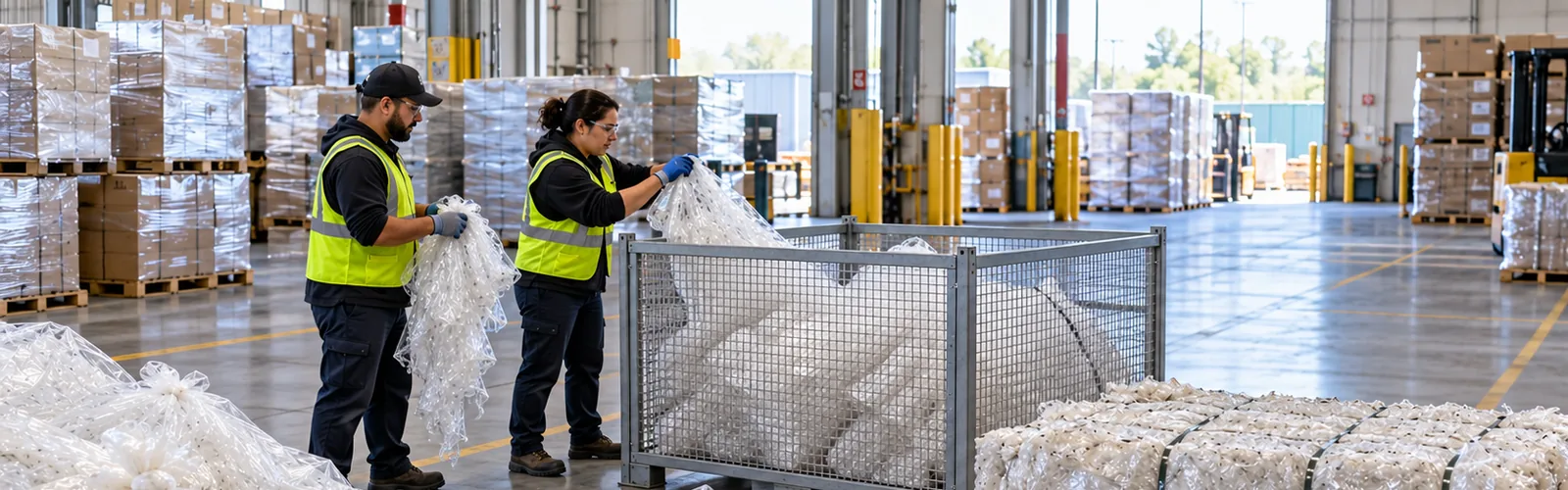
Plastic film recycling deserves a closer look when discarded wrap fills your waste container before the heavier rubbish does. But will separating it reduce your costs, or simply give your team another material to move?
For facility directors, plant leaders, and procurement teams, the answer depends on more than recyclability. This guide explains how to assess volumes, compare full costs, choose practical handling arrangements, and decide whether a managed recycling program fits your operation.
When Is Plastic Film Recycling Worth It?
A manufacturing plant removing wrap from inbound ingredients, a retailer unpacking deliveries, and a distribution center breaking down pallets can all generate film. Their economics will differ. Start with the actual material and service conditions at each location.
The strongest starting point is a regular stream of film a recycler will accept, enough protected storage between collections, and a handling routine employees can maintain. A large pile alone does not establish a business case: film occupies considerable space relative to its weight.
- Consistent volume: Measure accepted film over representative operating weeks, including delivery peaks. Record weight where practical rather than estimating solely from bag counts.
- Available outlet: Obtain written acceptance and preparation requirements from the proposed collector or processor before changing your sorting routine.
- Operational fit: Identify collection points, storage capacity, staff responsibilities, and a pickup arrangement that matches generation.
- Measurable benefit: Establish what would improve, whether actual disposal spend, handling time, usable space, or documented recovery, and how you will measure it.
The EPA’s commercial waste guidance recommends tracking waste and assessing its quantity and composition before selecting improvements. A short site assessment gives procurement a defensible baseline instead of a quote built around guesses.
What Does Plastic Film Recycling Really Cost?
Compare the whole arrangement over the same operating period. A low collection price can be outweighed by handling time, equipment commitments, or a requirement to accumulate more material than the site can safely store.
Collection and Transportation
Ask how pricing changes with material quantity, preparation, distance, and pickup frequency. Clarify minimum quantities, failed collection charges, contamination fees, and whether loading is included. Confirm how seasonal peaks and low-volume periods affect the arrangement.
Labor, Storage, and Equipment
Count the minutes spent separating film, moving bags, checking quality, preparing loads, and coordinating collections. Include bags or collection frames, equipment rental or purchase, maintenance, power, and any installation work relevant to the chosen setup.
Storage has a cost even without a separate invoice. An area used for accumulating film may displace inventory or add travel to a receiving task. Record those effects rather than treating floor space and existing employees as free.
Disposal Savings and Material Revenue
Removing film only creates a disposal saving if it changes a charge you actually pay. Under a fixed collection contract, lighter or less-full containers may leave the bill unchanged until service frequency, container size, or contract terms can be adjusted.
Clean, prepared film may have commodity value under suitable market and volume conditions. Request the applicable grade, deductions, freight terms, and rebate calculation in writing. Model the program with no material revenue as well, so a changing market does not erase the business case.
Use the following comparison to gather costs. Enter actual figures from invoices, time observations, and written quotes.
| Cost or Benefit | Current Disposal | Proposed Film Recycling |
|---|---|---|
| Collection | Current container and pickup charges | Film collections plus remaining trash service |
| Internal handling | Time moving film into trash | Sorting, bagging or baling, and loading time |
| Space and equipment | Current containers and storage | Collection area, supplies, and equipment costs |
| Material revenue | No separate recovery payment | Only confirmed terms; test a zero-revenue case |
| Evidence to review | Invoices and service records | Quotes, weights, fees, and recovery records |
A useful calculation is: net financial benefit = avoided disposal charges + material revenue − added collection, labor, storage, supplies, and equipment costs. Keep one-time implementation costs separate from recurring costs, then assess both over the proposed contract term.
What Can Your Facility Actually Recycle?
Identify the Film Your Operation Generates
Start where packaging is removed. Record stretch wrap from pallets, shrink film around products, and other flexible packaging as separate categories until the receiver confirms which can travel together. Include photographs and sample specifications where identification is uncertain.
Waste Harmonics Keter’s plastic film and shrink wrap service identifies clean LDPE film as a recoverable material where viable markets exist. Its wider plastic service also covers other material categories; that does not mean every plastic belongs in the same film load.
Check Contamination and Material Restrictions
Color, coatings, adhesives, laminated layers, and product residue can affect acceptance. Confirm how to handle labels, tape, straps, wet material, and any film that contacted chemicals or other potentially regulated substances. Keep uncertain material separate until its handling path is confirmed.
Do not assume a plastic film stream belongs in a general mixed recycling container. Obtain the specific collection instructions for your site. A clear acceptance sheet at the unpacking point is more useful than asking employees to identify a polymer from appearance alone.
Does Your Facility Need a Baler?
A baler can reduce the space occupied by loose film and change collection economics, but equipment is not automatically the first purchase. Confirm what bale dimensions, weight, material quality, and loading arrangements the receiving partner requires.
Think of loose wrap like an uncompressed sleeping bag in a car trunk: it fills the available space long before it becomes heavy. Compression helps use that space, but it cannot turn contaminated or unsuitable film into an accepted material.
- Loose collection: Evaluate it where the collector accepts bagged or contained film and the quantity can be stored and collected economically.
- Baling: Evaluate it where sustained volume, receiver specifications, and transport economics support the equipment and labor involved.
- Site readiness: Check floor space, power, access, loading arrangements, operating procedures, and manufacturer requirements before committing.
- Equipment responsibility: Establish who supplies, maintains, repairs, and trains employees on the machine, including the response to downtime.
Waste Harmonics Keter’s equipment and compactor services provide a relevant route for evaluating equipment support as part of the broader program. Ask for a site-specific recommendation rather than selecting a machine from a generic volume rule.
Collection storage must also fit the workplace. OSHA’s materials-handling standard, 29 CFR 1910.176, addresses clear aisles, safe clearances, stable storage, and hazardous accumulations. Plan film storage around those requirements; a recycling area should not obstruct a loading route.
What Can Go Wrong With the Program?
The difficult call usually comes after launch: procurement asks why the facility still pays the original trash bill while also paying for film collections and extra handling. That conversation is easier to prevent when the baseline, responsibilities, and service changes are agreed in advance.
- Rejected loads: Keep an agreed material list, check collection points, and document feedback from the receiver. Correct the source of contamination before the next shipment.
- Storage buildup: Set a practical collection trigger and a backup plan for missed pickups or delivery peaks. Assign an escalation contact.
- Repeated handling: Position collection points near unpacking work and define one route to final storage. Avoid moving bags between temporary piles.
- Unproven results: Reconcile collection weights and destinations with the reporting supplied. Distinguish collected material from confirmed recovery.
Across multiple facilities, standardize responsibilities and reporting while retaining each location’s acceptance rules and service arrangements. A single instruction to recycle all film everywhere can create problems if local receiving options differ.
How Waste Harmonics Keter Handles Plastic Film Recycling
Waste Harmonics Keter describes a managed plastic program built around mapping material types, volumes, existing containers, haulers, and costs by site. It then coordinates service and recycling partners, considers densification or baling where justified, and provides collection and recovery documentation.
That approach connects the facility’s daily handling problem with procurement’s need for a clear service scope. The assessment should establish which film is recoverable, how much accumulates, what preparation is required, and how the collection arrangement fits the site.
For operators managing several locations, its managed waste and recycling program brings vendor coordination, consolidated billing, equipment support, and reporting into one managed arrangement. The commercial value should be assessed through site-specific results, not an assumed percentage saving.
- Service fit: Review whether containers, equipment, and pickup arrangements match actual generation.
- Cost visibility: Compare total spend and fee changes with the original baseline.
- Recovery evidence: Review weights, chain-of-custody records, and material-specific recovery information.
Use these measures to judge the program after implementation. A successful collection is one event; a useful managed program also makes spending, responsibilities, and recovery outcomes easier to verify.
Is the Program Right for Your Facility?
The economic trade-off is blunt: an oversized baler and underused collections can cost more than the value they recover. An inadequate arrangement can leave employees shifting bags, contamination unresolved, and recyclable film in paid disposal. Both deserve a place in the comparison.
Before committing, confirm the accepted material, measure representative volumes, obtain a complete quote, and test the handling routine. Establish which disposal charges can change and who owns the collection and reporting tasks. If those details support the case, request a site assessment from Waste Harmonics Keter to evaluate an appropriate program.
Frequently Asked Questions
Can Facilities Recycle Film With Other Plastics?
Only where the receiving program explicitly accepts that combination. Plastic film recycling often has different preparation requirements from rigid plastics or mixed recyclables. Get written instructions for each material category and keep uncertain packaging out of the accepted film stream.
How Much Plastic Film Makes Collection Viable?
There is no universal minimum. Viability depends on the receiver’s requirements, collection distance, film quality, preparation, storage, and service costs. Ask for the quantity and frequency required under a specific quote, then compare those terms with measured generation.
Can Plastic Film Recycling Reduce Disposal Costs?
It can when diverting film allows a chargeable reduction in trash service or other disposal expense. Those benefits must be compared with recycling collection, labor, storage, and equipment costs. Removing film without changing a fixed trash charge does not automatically reduce the bill.
Can One Program Cover Multiple Facilities?
A managed program can coordinate several facilities, but acceptance and collection conditions still need to be confirmed by site. Waste Harmonics Keter describes a multi-location plastic service with coordinated collections and consolidated reporting. Request a location-level scope and a consistent method for measuring results.