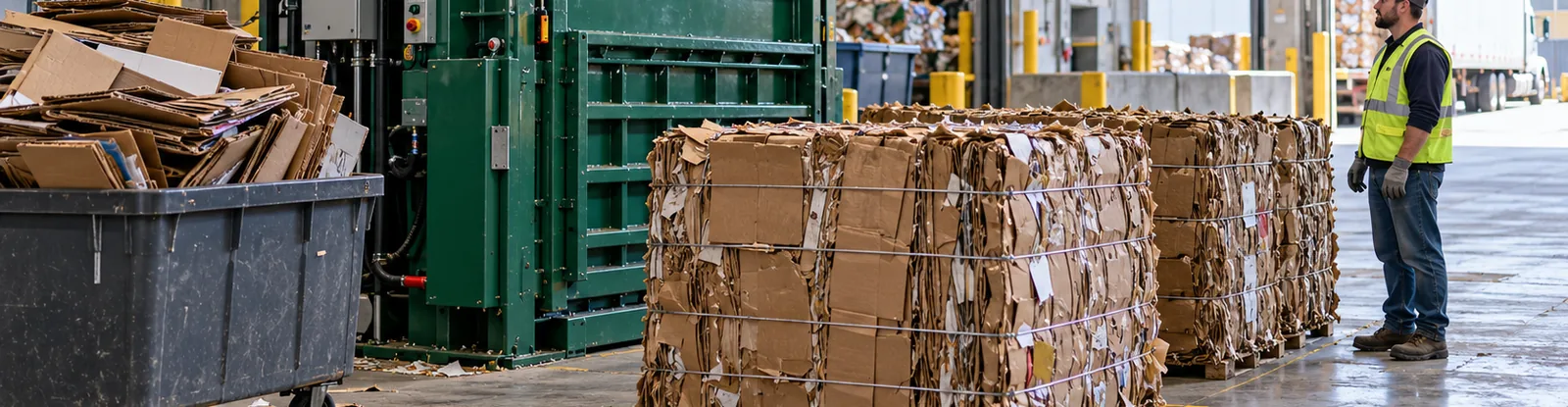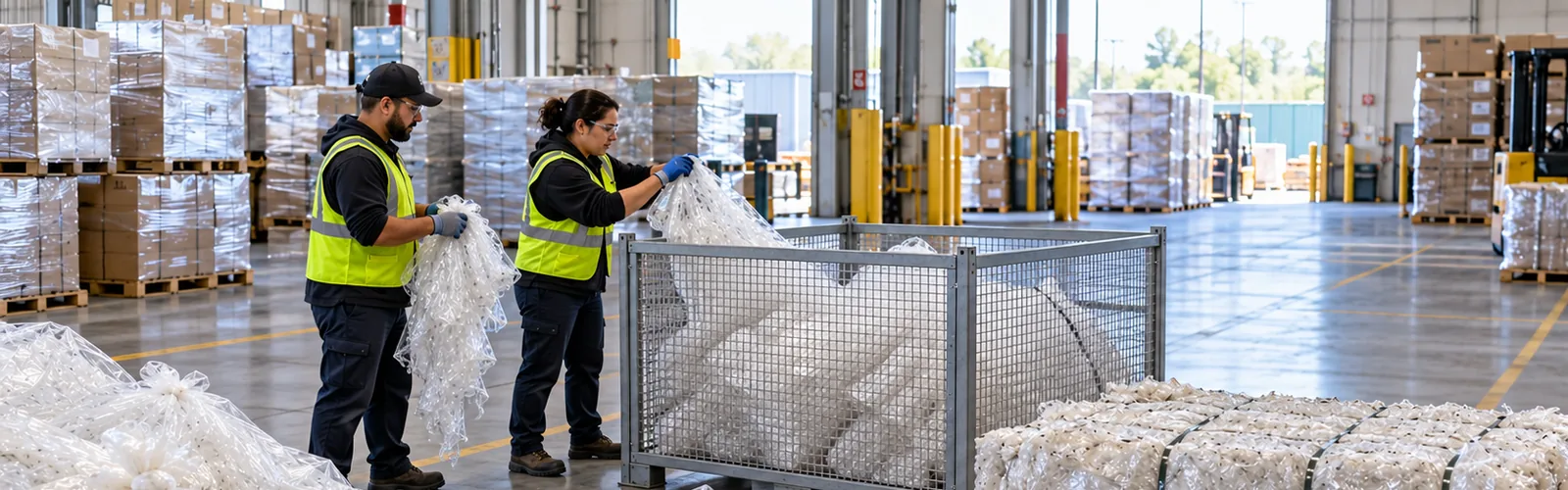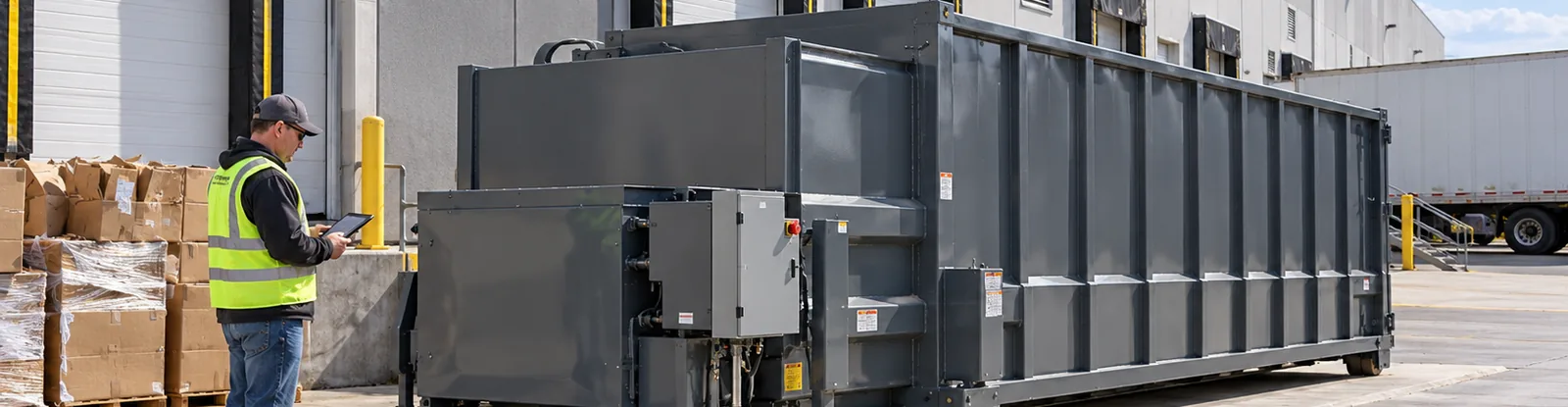
Cardboard stacked past the dock door. A container that was emptied Tuesday and is full again Thursday. Someone climbing in to stamp it down because the next truck isn't due until Monday.
That scene is why most facilities start looking at compaction. It is also why many of them buy the wrong machine. A commercial trash compactor is a haul-frequency tool, not a capacity tool, and the distinction decides whether the unit pays for itself or becomes a maintenance line item nobody budgeted for. For procurement and facilities leadership, the specification decision happens once and then sits on a concrete pad for ten years.
What a Commercial Trash Compactor Actually Changes
A compactor is the dock-sized version of pressing down on the kitchen bin before you tie the bag. The volume of waste does not change. What changes is how many times a truck has to come and get it.
That matters because hauling is priced per pull, not per pound of air. A site paying for five pickups a week on loose waste is paying four times for empty space. Compaction collapses that. Self-contained units typically hold two to five cubic yards and achieve roughly a five-to-one compaction ratio, which turns five pulls into one or two.
The honest limit is that this arithmetic only works above a volume threshold. A site generating two cubic yards a week will never recover the pad, the power drop, the install and the maintenance obligation. Below roughly a pull a week, a front-load container is the cheaper answer and the right one.
Self-Contained or Stationary, the First Fork
This is the decision that gets skipped, and it is the one that causes leaks, odor complaints and failed inspections later. It turns on a single question. Is your waste wet?
| Consideration | Self-Contained | Stationary |
|---|---|---|
| Best suited to | Wet waste and organics (food, cafeteria, produce) | Dry solid waste (cardboard, packaging, general MSW) |
| Construction | Compactor and container are one sealed unit | Compactor stays; container detaches and leaves |
| Liquid handling | Sealed body with a drainable sump | No liquid containment; leachate escapes |
| Typical capacity | Two to five cubic yards | Sized to the receiving container, commonly 30–42 cubic yards |
| Hauling | Whole unit is transported and returned | Container swapped, compactor stays in place |
| Cleaning burden | Hydraulics sit outside the charge box | Behind-the-ram cleaning needed more often |
Put dry cardboard in a self-contained unit and you have bought sealed containment you do not need, at a capacity that will have you hauling constantly. Put wet waste in a stationary unit and you have a leachate problem on your pad, an odor complaint from the tenant next door, and a pest issue by August.
Three Site Conditions That Decide It
These are physical constraints, not preferences. Confirm all three before anyone quotes you a machine.
- A concrete pad. Compactors are not placed on asphalt or gravel. The pad has to carry the unit loaded, and it has to be level enough that the container seats correctly against the charge box.
- Power at the location. Most units need three-phase power. If the nearest suitable supply is across the yard, the electrical work can exceed the first year of hauling savings.
- Truck access and swing room. A compactor that a truck cannot reach, or cannot line up with, is an expensive planter. Check the approach, the overhead clearance and the turning circle before the pad is poured, not after.
These are also the conditions that typically sit with the customer rather than the equipment provider. Waste Harmonics Keter handles freight, installation and the enclosure; site access, power and the pad are the customer's to supply. Knowing that split early prevents the install from stalling on site.
Sizing Against Volume, Not Guesswork
The single most common specification error is sizing from an opinion rather than a measurement. Start with a waste audit covering weekly volume in both cubic yards and weight, and talk with the staff who collect, empty and transport the waste. They know where the surges come from.
- Measure the peak, not the average. A distribution center in peak season and the same site in February are different facilities. Size for the week that hurts.
- Separate the streams first. If half the volume is cardboard, that volume may not belong in the compactor at all. Baled OCC is a recoverable asset; compacted OCC is a disposal cost.
- Count pulls, not fullness. The number that justifies the machine is how many hauls it removes per month, at your contracted per-pull rate.
- Plan for how you will know it is full. A compactor hauled at sixty percent is money leaving the site. Fill-level monitoring is what turns a sizing estimate into a verified cycle.
What the Wrong Unit Costs
Oversizing wastes capital on capacity that never fills, and a compactor hauled half-empty eliminates the saving that justified it. Undersizing produces overflow, emergency pulls at premium rates, and a dock that backs up during exactly the weeks it cannot afford to.
There is a third failure that is less obvious and more expensive, which is specifying for the waste you have today rather than the waste the site will have. A unit chosen for dry packaging, then asked to handle a new food program, corrodes. The cheapest compactor is not cheap if it rusts out in year four.
Who Is Allowed to Operate It
Worth confirming before a unit lands at a site staffed by younger employees. Under 29 CFR 570.63, operating or assisting to operate a paper box compactor is a prohibited occupation for employees under 18, and that includes placing or removing material and clearing jams. Employees aged 16 and 17 may load, but not operate or unload, and only where the equipment meets the applicable ANSI standard, the machine has a key-controlled on-off switch held by someone 18 or older, and a compliant notice is posted on the unit.
Setting up, adjusting, repairing, oiling or cleaning the machine is prohibited for under-18s outright. For a retail or warehouse operation with a young workforce, that shapes who can run the dock.
Renting a Compactor Without the Capital Risk
Waste Harmonics Keter rents compactors and balers rather than selling them, new or reconditioned, with freight, installation and the enclosure handled end to end and preventative maintenance and repairs managed as part of the program. OnePlus monitoring is installed on compactors and included within a managed contract at no separate platform fee, so fill level is measured rather than estimated and service is timestamped.
That matters most for the sizing problem above. A specification is a hypothesis until the unit runs; monitoring data is what confirms whether the cycle you specified is the cycle you got, and program optimization is where that data turns into a corrected haul schedule. Full detail on specification, install and maintenance sits on the equipment and compactor services page.
The Decision in One Line
If your site is paying for hauls rather than for capacity, and it can supply a pad, power and truck access, a compactor is the right tool, and the wet-or-dry question decides which kind. If any of those three conditions is missing, fix that first. A compactor on the wrong site does not solve a hauling problem; it adds a maintenance obligation to one.
Frequently Asked Questions
What compaction ratio should I expect?
Roughly five to one is typical for a self-contained unit on mixed waste. The achieved ratio depends on what is going in (dense wet waste compacts less than loose packaging), which is why the sizing audit should record weight as well as cubic yards. Treat any quoted ratio as a specification to verify against your own stream, not a guarantee.
Does a commercial trash compactor need 3-phase power?
Most commercial units do. Single-phase models exist at the smaller end, but they are the exception. Establish what supply is available at the intended pad location before the machine is specified, because running new service across a yard is frequently the largest unbudgeted cost in the whole install.
Should cardboard go in the compactor?
Usually not, if the volume is meaningful. Compacted cardboard mixed with general waste becomes disposal cost. Baled and kept clean, it is a recoverable commodity that can carry rebate value, though that value varies by market and is not guaranteed. Separating the stream before sizing the compactor often changes which machine you need.
Can we rent a compactor instead of buying one?
Yes, and for most multi-site operators it is the better structure. Renting keeps capital out of equipment that generates no revenue, and it moves maintenance and repair risk to the provider. The trade-off is a recurring cost rather than a depreciating asset, which suits sites where the waste profile may change.