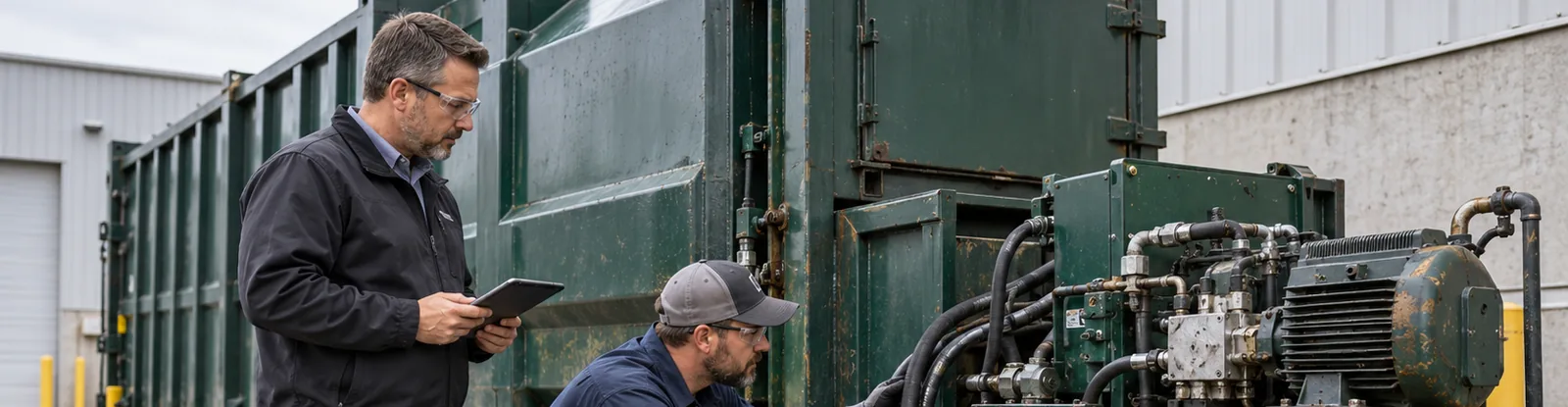
The call comes in on a Friday. The ram is stuck halfway, the container is three-quarters full, and the next truck isn't scheduled until Monday morning.
Everyone in that moment wants the same thing, to get it running. That instinct is right, and it is also why a trash compactor repair gets authorized well past the point where repairing the unit still makes sense. For facilities and finance leadership, the decision worth making is not about this breakdown. It is about whether this breakdown is the third one this year, and what that pattern is telling you.
What Actually Breaks, and What It Means
Compactor failures cluster into a small number of causes, and each one points somewhere different. The symptom matters less than what it indicates about how the machine is being used.
| Symptom | Likely Cause | What It Indicates |
|---|---|---|
| Ram slows or stalls mid-cycle | Low or degraded hydraulic oil, failing pump | Maintenance gap, usually recoverable |
| Visible fluid under the unit | Hose, fitting or cylinder seal failure | Repairable, but check for recurrence |
| Repeated hose failures | Contaminated oil abrading hoses internally | Systemic, oil and filter discipline has lapsed |
| Ram jams on load | Oversized or unsuitable material entering the charge box | Usage problem, training or stream separation |
| Structural cracking at pins or hooks | Sustained operation above rated capacity | Specification problem, the unit is undersized |
| Corrosion of the body or charge box | Wet or salty waste in a unit not built for it | Specification problem, replacement likely |
The last two are the ones to watch. A compactor that keeps breaking is rarely a broken compactor. It is usually the wrong compactor, working as hard as it can.
When Repair Becomes a Pattern
Industry maintenance guidance attributes premature failure to a short, consistent list, namely operating above rated capacity, skipping maintenance and lubrication, and ignoring early warning signs. Two of those three are correctable by changing behavior. The first is not.
Hose failures deserve particular attention because they are so often misread as bad luck. External damage (cuts, kinks, rubbing against clamps) is visible and preventable. The more consequential cause is internal. Contaminants from eroding valves and pumps circulate in the oil and abrade hoses from the inside. A site replacing hoses repeatedly does not have a hose problem. It has an oil problem that is quietly consuming the rest of the hydraulic system.
A Repair or Replace Threshold You Can Defend
Finance will ask why this unit and not another. These are the criteria that hold up in that conversation.
- Repair frequency over twelve months. Three or more unplanned failures in a year, on a unit that is being maintained, is a replacement signal regardless of individual repair cost.
- Cause classification, not cost. Wear-item failures (hoses, seals, filters) are normal aging. Structural failures and corrosion are terminal, because they indicate the machine is mismatched to the duty.
- Cumulative repair against replacement value. Once twelve months of repair spend approaches a meaningful share of what a comparable unit would cost to put in service, the arithmetic has already turned.
- Downtime cost, counted honestly. Emergency pulls at premium rates, overflow clean-up, labor standing idle at the dock. This is usually larger than the repair invoice and it is almost never in the comparison.
- Remaining service life against the contract. Repairing a unit that will be replaced in eighteen months is a different decision from repairing one expected to run another eight years.
The trade-off is genuine in both directions. Replacement costs capital and creates a changeover window where the site still has to get waste off the dock. Repair is cheaper per event and compounds silently. The point of the threshold is to stop the decision being made in the panic of a Friday afternoon.
The Cost That Never Appears on the Invoice
A failed compactor does not stop at the compactor. The dock backs up, cardboard goes somewhere it should not, and an emergency haul gets booked outside the contracted schedule. In a distribution environment, equipment downtime halts dock flow directly, which is a labor cost long before it is a waste cost.
There is a quieter version of the same problem. A faulty pressure gauge can cause over-compaction that damages the unit or the container, and it can also trigger hauls when the container is not actually full, which means paying for pulls that were never needed. Neither shows up as a breakdown. Both show up in the budget.
What Prevents Most of This
Most compactor failures are scheduled events that nobody scheduled. A standard maintenance rhythm covers the majority of them.
- Weekly. Check hydraulic oil level; inspect hoses and fittings for leaks, cuts, kinks and missing clamps.
- Monthly. Visual inspection, greasing, lubricating ram contact surfaces, checking oil condition, inspecting cylinder pins and turnbuckles for stress fractures.
- Yearly. Drain and refill the hydraulic tank, replace the oil filter and air breather, check fasteners and anchor bolts.
- Continuously. Keep material within rated capacity, and keep the things that should not be in the charge box out of it.
The oil-and-filter item is the one that pays for itself most reliably, because it protects every other hydraulic component from the internal abrasion described above.
Who Is Allowed to Repair It
Worth stating because it is widely missed at site level. Under 29 CFR 570.63, setting up, adjusting, repairing, oiling or cleaning a paper box compactor is a prohibited occupation for employees under 18. So is clearing a jam, which counts as operating the machine.
For a site that relies on younger staff, that means the routine lubrication and cleaning above cannot be delegated to whoever is nearest. It is a maintenance responsibility that has to sit with qualified adults or with the equipment provider.
Waste Harmonics Keter Takes Repair Decisions off Your Desk
Waste Harmonics Keter rents compactors and balers rather than selling them, and preventative maintenance and repairs are managed within the program rather than billed as surprises. That changes the structure of the decision above. The repair-versus-replace judgment, and the cost of getting it wrong, sits with the provider rather than appearing as an unplanned line in a facilities budget.
Equipment carries OnePlus monitoring, included within a managed contract, which reports real fullness on hydraulic compactors and timestamps service so hauls can be verified rather than assumed. The faulty-gauge problem described above (hauling a container that is not full) is exactly what measured fill level removes. Specification, install and maintenance detail sits on the equipment and compactor services page, and the broader program on managed waste and recycling.
Stop Pricing Repairs, Start Asking Why
Repair the first failure and the second. When the third arrives in the same twelve months, stop pricing the repair and start asking what the machine is being asked to do, because a compactor that keeps failing on a maintained schedule is usually telling you it was specified for a different site than the one it is standing on.
Frequently Asked Questions
How often should a commercial compactor need repair?
Wear items such as hoses and seals will need periodic attention across a unit's life, and that is normal. Unplanned failures stopping the machine should be rare on a maintained unit. Three or more in a year is the point at which the pattern, rather than the individual fault, is the thing to investigate.
Why do our hydraulic hoses keep failing?
If replacement hoses fail repeatedly, the likely cause is inside the system rather than outside it. Contaminants from eroding valves and pumps circulate in the hydraulic oil and abrade hoses internally. Regular oil and filter changes address the root cause; replacing hoses alone treats the symptom while the contamination continues.
Does trash compactor repair downtime add haul cost?
Usually, yes. A unit out of service means waste accumulates uncompacted, which commonly triggers emergency pulls outside the contracted schedule at premium rates. That cost is frequently larger than the repair itself and should be included when comparing repair against replacement.
Is a reconditioned compactor a sensible replacement?
It can be, provided the specification matches the duty. A reconditioned unit correctly sized for the stream will outlast a new unit that is undersized or unsuited to wet waste. The question to settle first is why the previous machine failed. If the cause was specification rather than age, repeating the specification repeats the outcome.