Managing cardboard recycling across multiple locations? The challenge is rarely finding a recycler. It is getting every site the right equipment, dependable pickups, consistent pricing, and records procurement can verify.
A distribution center, retail backroom, and manufacturing plant will not generate cardboard the same way. A strong multi-site program standardizes decisions and reporting while adapting service to the workload at each facility.
Compare Multi-Site Program Models at a Glance
The service model determines how much coordination stays with your internal team. Compare the operating responsibility behind each option before comparing quoted rates.
| Program Model | Best Fit | Primary Trade-Off |
|---|---|---|
| Site-managed local vendors | Few sites with strong local oversight | More contracts, invoices, and escalation paths |
| One national service specification | Similar facilities with consistent needs | Can over- or under-size individual sites |
| Managed multi-site program | Mixed facilities needing central control | Requires clear site data and provider governance |
Start With a Site-Level Cardboard Baseline
A national recycling plan built from one average volume will mis-size service at many locations. Begin with a site inventory that records how cardboard enters the operation, where it accumulates, how employees handle it, and how it leaves the property.
EPA’s commercial waste management guidance recommends tracking the materials and quantities an organization generates before evaluating improvements. For a multi-site program, use one data template so every facility reports the same measures and definitions.
- Cardboard volume: Capture available weights, container capacity, pickup frequency, and seasonal peaks. Label estimates clearly.
- Material condition: Record moisture, food residue, plastic film, pallets, and other materials that appear in the cardboard stream.
- Current service: List haulers, recyclers, equipment, rates, extra fees, contract dates, and recurring service problems.
- Site constraints: Document loading areas, storage space, access windows, power, landlord rules, and local operating restrictions.
- Internal labor: Estimate the time spent flattening, moving, baling, staging, and rehandling cardboard on each shift.
Use at least one representative normal period and one peak period. A single quiet-week observation can produce equipment and pickup schedules that fail when inbound inventory increases.
Standardize the Decision, Not Every Site
Standardization should create one method for selecting service, not force identical equipment into different operations. Set common rules for assessing volume, material quality, labor, storage, pickup risk, and reporting. Then use those rules to choose the right design for each location.
Think of the program like a company travel policy. The approval rules and expense categories stay consistent, but every employee does not take the same flight. In the same way, each facility can use a different container or schedule while procurement keeps one decision framework.
Group similar sites into operating profiles such as high-volume distribution centers, manufacturing plants, retail locations, and small offices. Define a standard starting configuration for each profile, then adjust it with documented site evidence.
Right-Size Equipment and Collection
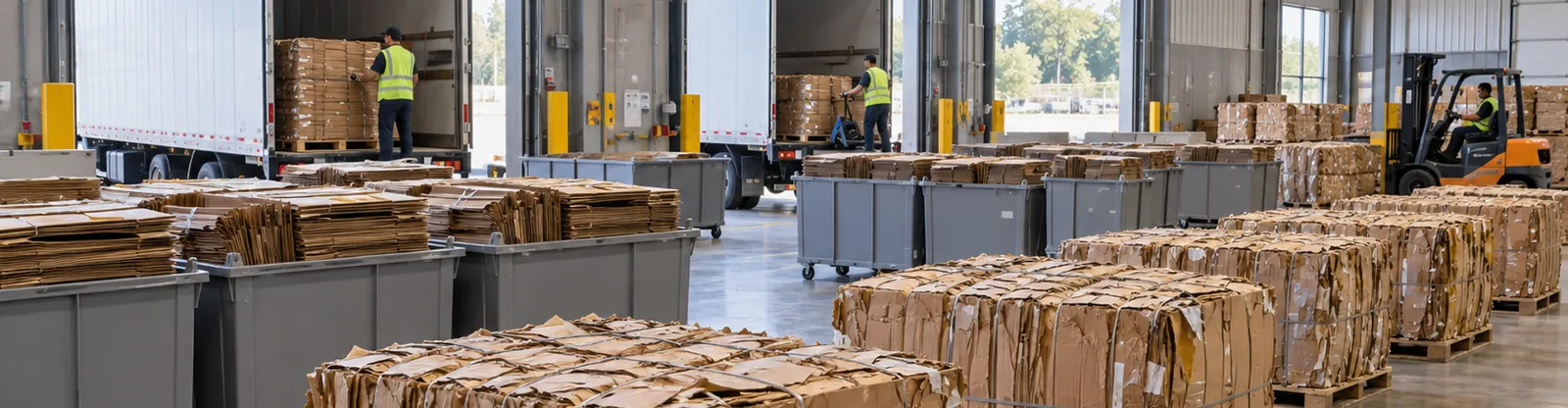
Loose cardboard collection may work for smaller sites with adequate storage and reliable service. Higher-volume operations may benefit from balers or other equipment that reduces storage and transport demands. The right choice depends on material flow, labor, space, and downstream acceptance requirements.
Before approving equipment, confirm throughput under actual site conditions, finished bale requirements, electrical and installation needs, access clearances, employee workflow, maintenance coverage, and the method for moving completed bales. A machine specification does not describe the full operating process.
Waste Harmonics Keter’s equipment and compactor services include assessing site needs, coordinating equipment and installation, and managing maintenance and repairs. Put the exact equipment scope, response process, and site responsibilities into the proposal.
Storage and handling plans must also support safe operations. The federal materials-handling standard in 29 CFR 1910.176 addresses clear aisles and stable storage. A program that depends on cardboard spreading into travel paths needs more capacity or faster service.
Set Pickup Standards and Escalation Rules
Each site needs a regular service plan plus a clear path for predictable peaks and unexpected overflow. Define collection windows, access instructions, confirmation methods, and the time within which the provider must acknowledge and resolve a missed pickup.
The awkward phone call comes when a plant manager reports a blocked receiving area, the local hauler says the account is controlled elsewhere, and procurement cannot tell who owns recovery service. Every hour spent routing that complaint is part of the program’s cost.
Assign one accountable program contact, but keep local service details visible. Site teams should know how to report a missed collection, and procurement should be able to see the ticket, response, completion time, and any added charge.
- Routine service: Specify days, service windows, access requirements, and proof of completion.
- Peak demand: Define how sites request temporary capacity or extra pickups and who approves the cost.
- Missed pickups: Set an acknowledgment target, recovery commitment, escalation path, and documentation requirement.
- Blocked service: Require photographs or other evidence and state how attempted-service fees are reviewed.
- Service changes: Document who can change frequency, equipment, or location-level scope.
Control Contamination Across Locations
Material acceptance rules can vary by recycler and destination. Request written requirements for corrugated cardboard, paperboard, coatings, moisture, food residue, and mixed packaging at every location. Avoid a single instruction that is too broad to match the receiving facilities actually used.
Turn those rules into short sorting instructions placed where employees unpack materials. Use the same format across the company, with site-specific exceptions where needed. Identify who reviews contamination notices and updates training after packaging or operations change.
Require photographs, inspection findings, weights, and the pricing basis for contamination or rejected-load charges. A location should be able to correct a real problem without procurement paying unexplained deductions across the network.
Build One Cost Model for Every Proposal
Compare providers with a consistent total-cost model: recurring service, equipment, installation, handling labor, maintenance, extra pickups, variable fees, and internal administration, minus documented recycling credits. Use the same period and operating assumptions for every bidder.
Do not let a favorable pickup rate hide high equipment charges or frequent add-ons. Likewise, do not treat a projected cardboard rebate as guaranteed savings. Material grade, contamination, payable weight, transport, and commercial terms determine the actual net result.
Ask each provider for a sample invoice and a sample recycling settlement. Trace the service event, weight, charge, credit, and approval path. If the program includes local subcontractors, define which costs may pass through and what supporting evidence is required.
Create Reporting Procurement Can Reconcile
A consolidated dashboard is useful only when the underlying records are consistent. Establish definitions for material type, serviced weight, recycled weight, estimated weight, contamination, rejected material, destination, and diversion. Apply those definitions across every site and reporting period.
Require site-level detail even when billing is consolidated. Procurement should be able to move from a portfolio total to the location, service date, material, weight basis, destination, and invoice line that produced it.
- Operational measures: Completed pickups, missed pickups, overflow events, extra services, and equipment downtime.
- Material measures: Weight by site and stream, measurement method, contamination, rejections, and destination.
- Financial measures: Recurring charges, variable fees, equipment costs, credits, and total net cost by location.
- Program measures: Cost per measured ton, service exceptions, data completeness, and corrective actions.
Collection tonnage alone does not prove that all collected material was recycled. Ask the provider to explain how downstream processing, contamination, and rejections affect reported diversion and what documentation supports the claim.
Plan the Rollout Around Operational Risk
Start with a representative group of facilities rather than the easiest locations alone. Include at least one high-volume site, one location with service problems, and one lower-volume site. That mix tests the program’s equipment, escalation, invoicing, and reporting under different conditions.
Set a baseline and a limited group of success measures before launch. Useful measures include completed collections, overflow incidents, handling time, equipment downtime, total net cost, invoice exceptions, and reporting completeness.
Review results with facility leaders and procurement before expanding. Fix unclear responsibilities and data gaps while the program is still small enough to adjust quickly.
Face the Cost of Over- and Under-Standardizing
Over-standardizing can place unnecessary equipment and service at smaller sites. Under-standardizing leaves procurement managing scattered contracts, inconsistent fees, and data that cannot be combined. Both choices create costs that may sit outside the recycling invoice.
Invest in common controls where scale matters: vendor governance, reporting definitions, invoice review, escalation, and performance management. Keep equipment and pickup frequency tied to measured site needs. This balance preserves purchasing control without forcing every location into the same physical setup.
How Waste Harmonics Keter Manages the Network
Waste Harmonics Keter’s managed waste and recycling program provides a central coordination point for multi-location service. For cardboard, its published approach includes assessing site volume, existing containers or balers, current haulers, and costs before right-sizing collection and equipment.
The company’s cardboard and OCC recycling service also describes scheduled pickups, weights, chain-of-custody records, and consolidated activity and diversion reporting. These capabilities can help procurement reduce vendor handoffs, compare site performance, and reconcile service with invoices.
A proposal should still define the local service design, equipment responsibilities, escalation process, report fields, and commercial terms for your locations. Use those commitments as the operating standard for the program.
Build a Program That Works at Every Site
A successful multi-site cardboard recycling program combines central control with site-level fit. Start with consistent baseline data, group facilities by operating profile, and select equipment and pickups from measured needs. Then hold the program together with one escalation path, one cost model, and reporting that procurement can audit.
Frequently Asked Questions
Should Every Location Use the Same Baler?
No. Use the same evaluation method across sites, then select equipment from local volume, material condition, labor, space, power, and downstream requirements. Similar facilities may share a standard configuration, but exceptions should be supported by a site assessment.
Can One Provider Manage Different Local Haulers?
Yes, a managed program can coordinate services delivered by different local providers. The agreement should identify the accountable program contact, local service details, escalation process, invoice controls, and reporting requirements so facility teams know how issues are resolved.
How Should Cardboard Recycling Be Reported?
Report site, service date, material, weight and measurement method, destination, contamination or rejection, charges, and credits. Keep collected weight separate from verified recycled weight when the downstream outcome differs or is not yet documented.
How Often Should Multi-Site Programs Be Reviewed?
Review operational exceptions and invoice issues monthly during rollout. Reassess equipment and service when volumes, packaging, production, store formats, or facility access change. Schedule a broader performance and commercial review at least annually or before contract renewal.