
Some small businesses believe environmental, social, and governance (ESG) reporting is only for large corporations. The truth is that small businesses can significantly impact ESG performance. In fact, small and medium-sized (SMEs) enterprises play a crucial part in the domestic and global ESG movement. An effective ESG strategy begins with understanding the pros, cons, and best practices of ESG reporting for small businesses.
Why Should Small Businesses Care About ESG?
When it comes to sustainability, smaller businesses are starting to realize they matter just as much as major corporations. Collectively, SMEs have an enormous impact on social and environmental issues. This impact stems from their workforce policies, supply chain relationships, and community ties.
According to the U.S. Chamber of Commerce, small businesses—independent businesses with fewer than 500 employees—account for over 90% of all U.S. firms. Yet only a fraction of small businesses currently report on their ESG performance. Tracking and disclosing these indicators according to established reporting standards allows companies to manage risks better and operate efficiently. Additionally, it enables them to conduct a more ethical business overall.
Small enterprises getting ahead of the ESG curve can enjoy both public relations and bottom-line benefits, including:
- Leadership: As pressure mounts globally for businesses to demonstrate accountable and responsible practices no matter the size, ESG reporting becomes increasingly important. This presents a prime opportunity for SME leadership.
- Investment opportunities: Reporting environmental, social, and governance metrics appeals to investors focused on sustainability. This approach helps small businesses attract values-aligned investors and funding opportunities. As a result, it gives them access to capital that might otherwise go to larger businesses.
- Hidden costs: Monitoring environmental metrics often reveals resource waste and operational inefficiencies. Addressing these excess costs in energy, water usage, and materials results in significant cost savings, benefitting your bottom line.
- Competitive edge: More and more buyers are taking social responsibility into account when considering companies to fulfill large contracts. Your sustainability efforts could put you on even footing with a larger supplier, pushing you ahead of the local competition.
- Corporate responsibility: Now more than ever before, companies are expected to conduct business responsibly and sustainably. Forward-thinking enterprises no longer see public good and shareholder returns as mutually exclusive.
- Stakeholder engagement: Your accessibility to your stakeholders is your superpower. You’re not a faceless CEO who only exists on letterhead. You’re the head of a thriving enterprise that meets challenges face-to-face. Operating a small company allows you to choose which changes to make and how to implement them. This flexibility gives you a faster response time than larger companies.
- Brand value and consumer trust: A strong ESG focus helps showcase commitments that resonate with ethically minded shoppers. In addition to attracting more customers, ESG disclosures help buyers identify businesses aligned with their social and environmental values.
- Enhanced business resilience: As public sentiments and market valuations shift toward conscientious conduct, there’s a noticeable trend. Eco-friendly products and practices are delivering outperformance over the long term. Tracking key ESG criteria helps owners make informed decisions. This insight better positions small companies to mitigate and adapt to growing regulatory demands.
- Employee recruitment and retention: When assessing job opportunities, employees, especially Millennials and Gen Z, increasingly factor in climate change and corporate sustainability. ESG reporting standards and purpose-driven practices help attract and keep top talent.
ESG Challenges for Small Businesses
Implementing your new ESG program will be rewarding, but that doesn’t mean it will be easy. Potential challenges you may face include:
- Lack of resources: Small businesses may not have the staff, budget, or expertise to track ESG metrics. Business owners may find it hard to devote resources away from core business activities. As a result, they often opt for less robust data-gathering systems, which are prone to incomplete or inconsistent data.
- Scale: Knowing which measures to implement first and how to approach certain problems can be difficult. Determining which solutions will deliver the best results is also challenging. Overreaching is common when SMEs are under pressure to meet the same ESG standards as larger companies.
- Supply chain access: Large operators have the power to demand transparency in their extended supply chains. However, for smaller competitors, supplier tracing and auditing prove more demanding.
These challenges are not insurmountable, but they require small businesses to get creative. The key is embarking on the sustainability journey in earnest, leveraging partnerships. It’s also crucial to approach ESG tracking using the means and resources at hand.
How to Plan Your ESG Strategy
Be aware before you rush to install solar panels or upgrade your company vehicle to an electric model. Consumers are wise to greenwashing tactics. You need more than the appearance of a commitment to sustainability. You need to demonstrate both personal and capital investment. Incorporating risk management into your ESG strategy is essential for a comprehensive approach.
Taking control of your ESG efforts begins with a clear statement of purpose and a plan for integrated solutions. Here are a few diagnostic questions to start you off on the right foot when improving your ESG strategy:
Environmental
- Where do you get your raw materials?
- Where are your products sourced?
- Are your suppliers making an effort to reduce environmental risks?
- Would your customers pay more for eco-friendly products?
Social
- What is your employee turnover rate?
- What are the biggest dangers in your employees’ work environment?
- How diverse is your workforce, management, and board?
- What are the working conditions like in your supply chain?
- What do your customers and employees care about?
- Does the local community have any concerns about your business?
Governance
- Does your company's mission statement include environmental and social aspects?
- Do your operating agreements allow for ESG transparency?
- Are you sharing your ESG results and future goals with your shareholders?
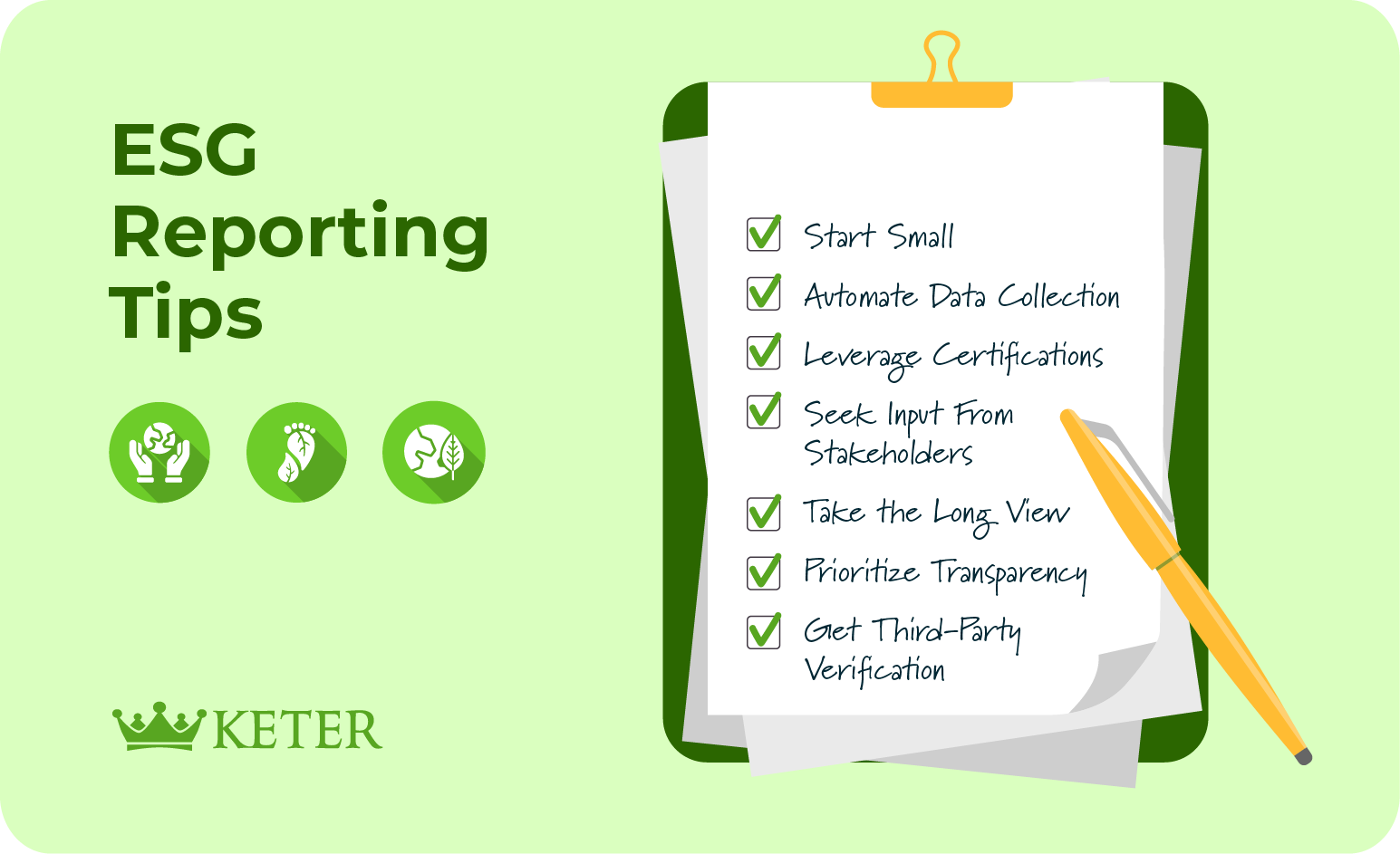
ESG Reporting Tips for Small Businesses
Sustainability reports don't need to be heavy tomes with endless lists of numbers. In fact, the most effective reports contain direct and concise information. They often highlight the top issues where a company can drive real impact. To develop a robust ESG strategy, here’s how to get started:
Start Small
Don't let the scope of full ESG reporting deter your initial steps. Gradually increasing your reporting progress makes for more consistent and accurate data. This improved data quality allows you to make well-informed decisions over time.
- Begin tracking a couple of key metrics.
- Focus your reporting on your business's most relevant ESG factors, such as emissions, waste management, data privacy, or employee diversity.
- Spotlight the few ESG issues of the highest priority and relevance in the main report through compelling narratives and data.
- Provide supplemental data sets on secondary ESG factors that are still important to stakeholders but are not a core strategic focus. This supplemental data can come in appendices, a searchable database, or separate disclosures.
Automate Data Collection
Develop integrated systems to compile ESG data points automatically rather than tracking them manually. This saves time, increases accuracy, and enables setting performance targets. Lean data templates can further simplify data collection. Our waste management analytics standardize and organize key performance indicators (KPIs) for straightforward reporting.
Leverage Certifications
Respected certifications like B Corp or Climate Neutral validate your ESG commitments and provide a guided framework for what metrics to track and report.
- Disclose and promote certification logos publicly to showcase your ESG efforts.
- Make sure your accounting team has a plan to offset certification fees for auditing procedures and yearly renewals.
Seek Input From Stakeholders
ESG doesn’t exist in a vacuum. You need to implement feedback systems and respond to concerns so your stakeholders feel heard. Your employees and investors will want data across a wide range of ESG topics. This demand occurs regardless of whether they make up a core sustainability focus for the business.
- Survey employees anonymously regarding workplace culture, pay equity, and training opportunities at regular intervals.
- Meet with community groups and NGOs to understand local social and environmental justice needs and determine partnership opportunities.
- Collaborate with vendors and suppliers to reduce emissions across the supply chain.
Take the Long View
Investment in sustainability and wage equity may cut into profit margins in the short term. This reduction can make justifying longer-term benefits challenging. Keep a close eye on your margins as you implement each change. Also, set a clear time goal for when to reach breakeven and profit. Seeing returns on renewable energy and recycling often spurs companies to invest in more beneficial initiatives down the line.
Prioritize Transparency
ESG reporting isn’t just about acknowledging your successes. It also requires taking ownership of shortcomings and recognizing areas that need improvement.
- Disclose trade-offs of balancing profit and purpose.
- Transparently communicate instances when sustainability goals conflicted with financial bottom lines.
- Outline decision-making processes and how resolutions align with your values. This builds trust and accountability.
Get Third-Party Verification
Stakeholders will expect verified reports on sustainability impacts before investing in your enterprise. Even small companies with limited resources can get external assurance of ESG data with a few simple steps.
- Build robust database systems to record and analyze data
- Partner with experts to audit selectively without high costs
- Use respected certifications (such as B Corps) for partial external evaluations
Let WHK Handle Your Environmental Reporting From Start to Finish
Looking for sustainability reporting you can trust? Contact us today to find out how Waste Harmonics Keter simplifies your waste reporting and provides end-to-end sustainable waste management. Contact us today for answers to your questions, or schedule a 30-minute demo with one of our experts!