Corporate America is knee-deep in environmental action, and a fundamental pillar of any sustainability program is enhanced landfill diversion.
Landfill diversion creates an incredible opportunity to do good as a business, employer, and community partner. It involves reducing waste, including packaging materials and trash sent to landfills, which have significant environmental benefits.
However, the responsibility of environmentally friendly waste disposal does not sit solely with large corporations. Companies of all sizes can do their part to become environmental stewards—and reap the benefits.
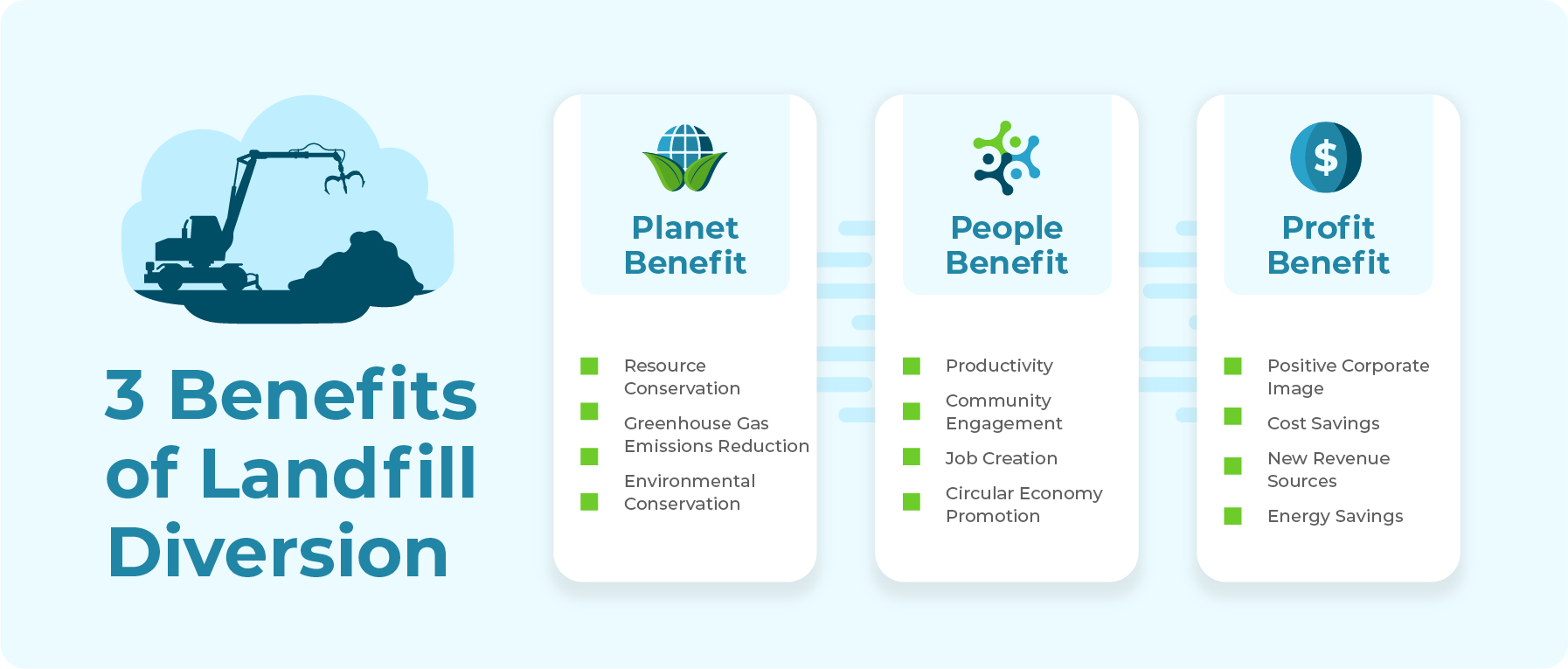
1. Planet Benefit: Champion Environmental Sustainability
Landfills have a significant impact on the environment around us. Waste diversion means less garbage piling up at landfills, helping extend the lifespan of existing landfills and postponing the need to develop new landfill sites.
This reduction in waste and trash is essential for long-term environmental sustainability. Often, new landfills are challenging to establish due to environmental and community concerns. This challenge is why landfill diversion should be critical to any business’s environmental reduction or net-zero economy plans.
Companies that proactively work to enhance their diversion rate—or cut out landfill waste generation altogether—are doing their part to protect the long-term sustainability of our global environment through:
Resource Conservation
Recycling and reusing existing items in the waste stream reduces the demand for raw materials, protecting our reserve of valuable natural resources. Less extraction and production of new materials also conserves energy and reduces industrial pollution.
Greenhouse Gas Emissions Reduction
Landfills are significant sources of methane, a potent greenhouse gas. While global warming is frequently attributed to carbon dioxide, the methane emissions from landfills are 23 times more powerful than CO2 emissions. Waste diversion practices like composting and recycling help reduce methane emissions and mitigate climate change impacts.
Environmental Conservation
Diverting waste from landfills reduces environmental degradation by minimizing the need for additional landfill space, preventing soil contamination, and decreasing water pollution. It also reduces the need for incineration, further protecting the atmosphere and public health.
2. People Benefit: Elevate Workforce Efficiency
Today, companies risk losing their top and emerging talent when their sustainability values do not align. Why? Because employees value businesses that prioritize positive environmental behavior. Younger workers view corporate sustainability as a major factor when choosing an employer, with greener industries enjoying a more innovative and energized workforce.
Waste diversion often leads to higher:
Productivity
Employees are more loyal to companies that match their values and are more engaged and motivated to do good work. Organizations that take proactive environmental policies boost employee productivity.
Community Engagement
Waste diversion initiatives, such as recycling programs and donation efforts, foster community engagement and awareness, contributing to a sense of environmental responsibility and sustainability.
Job Creation
The recycling and waste diversion industry creates jobs in the collection, processing, and manufacturing of recycled products, contributing to economic growth.
Circular Economy Promotion
Diverting waste supports the transition to a circular economy, replacing the linear "buy, use, dispose" model. By emphasizing the reuse, recycling, and repurposing of materials, businesses raise awareness of personal and corporate social responsibility, establishing a common goal between employees and their workplace.
3. Profit Benefit: Boosting the Bottom Line
If 2020 taught businesses anything, it’s that people, planet, and perceptions are essential to positive company performance. Corporations now have a responsibility to their stakeholders to address climate change and reduce their negative environmental impact. One crucial way to do that is through landfill diversion.
Diversion drives bottom-line results through:
Positive Corporate Image
Companies taking environmental action enhance their reputations and strengthen their relationships with employees, investors, customers, and suppliers. Businesses and organizations that actively participate in waste diversion activities enhance their corporate social responsibility (CSR) profile, appealing to the environmentally conscious.
Cost Savings
Effective waste diversion strategies can lead to cost savings for businesses through reduced disposal fees, elimination of landfill fines, decreased demand for raw materials, and early adoption of mandatory clean air and water practices. These cost-saving measures align with reducing waste and trash generation.
New Revenue Sources
Diversion is beneficial; it could be profitable for your business. Many components in industrial waste—such as precious metals, steel, plastics, cardboard, packaging, and electronic components—are valuable materials that might be useful to neighboring businesses. The right buyer may be willing to haul away valuable waste and pay you for the privilege!
Energy Savings
Recycling and reusing materials often require less energy than manufacturing products from raw materials. This practice contributes to power conservation, lower energy costs, and a more sustainable energy balance.
How Much Waste Can I Divert From the Landfill?
If recycling and reuse programs are the first steps in diversion, the ultimate goal is to waste as little as possible, a movement known as Zero Waste to Landfill. Any company wishing to qualify as “zero waste" must divert at least 90% of its trash, sending less than 10% of all refuse to the landfill.
Does it sound impossible? Not so! Every day, new technological innovations emerge to increase recycling rates, cut source production, and extend the lives of necessary products. Many companies plan to become zero waste within the next decade, setting smaller goals (such as a 50% diversion of non-hazardous waste per year) as milestones along the way.
Barriers to Zero Waste-to-Landfill Goals
Cost is the most common problem cited by companies that fail to meet sustainability standards. Diversion requires labor, specialized equipment, time, and energy which may be in short supply in a small business.
- Lack of Infrastructure: Insufficient infrastructure, such as recycling facilities or food waste composting centers, can hinder the ability to process and divert waste effectively, especially in regions where waste management facilities are limited.
- Startup Costs: The initial costs of implementing waste diversion programs or investing in advanced recycling technologies can be a significant barrier, especially for smaller businesses or organizations with limited budgets.
- Regulatory Compliance: Adhering to complex and evolving waste regulations can be challenging, particularly for businesses operating in different regions with varying waste disposal requirements.
- Consumer Behavior: Overcoming ingrained consumer habits and promoting behavior change towards sustainable practices, such as recycling and composting, can be a substantial barrier to achieving zero-waste-to-landfill waste goals.
- Product Design Challenges: Some products are inherently difficult to recycle due to complex materials or designs. Reducing or eliminating non-recyclable materials may require changes to product design and manufacturing processes.
- Supply Chain Issues: Achieving zero waste goals often involves collaboration across the entire supply chain. Challenges may arise in coordinating efforts and consistently ensuring suppliers and partners adopt waste-reduction practices.
- Lack of Awareness and Education: Employees, consumers, and stakeholders need more awareness and education about waste reduction, improper incineration, and recycling practices to ensure progress toward zero-waste-to-landfill goals.
- Limited Market for Recycled Materials: The need for robust markets for recycled materials can create challenges for businesses looking to sell or repurpose recycled content, affecting the economic viability of waste diversion efforts.
- Logistical Constraints: Challenges in logistics, such as transportation and sorting of waste materials, can hinder the efficient collection and processing required for successful waste diversion programs.
- The Wrong Partner: You and your waste management company must be on the same page regarding sustainability. Some disreputable companies may have more to gain by throwing recyclables into the garbage, charging customers higher landfill rates while lowering their operating costs. This practice can result in increased waste and packaging waste sent to landfills, undermining the focus on sustainability. Even if waste management companies don’t profit from the volume of waste, they don’t necessarily have a vested interest in diverting potential recyclables or connecting clients to companies that might purchase their waste materials.
Don’t lose heart; there are ways to overcome the challenges of sustainable waste management. Our team offers end-to-end solutions tailored to your specific needs, helping you find the right balance as you move toward zero waste.
Ready to Take Your Waste Management Program to the Next Level?
Talk with a real person from our team.