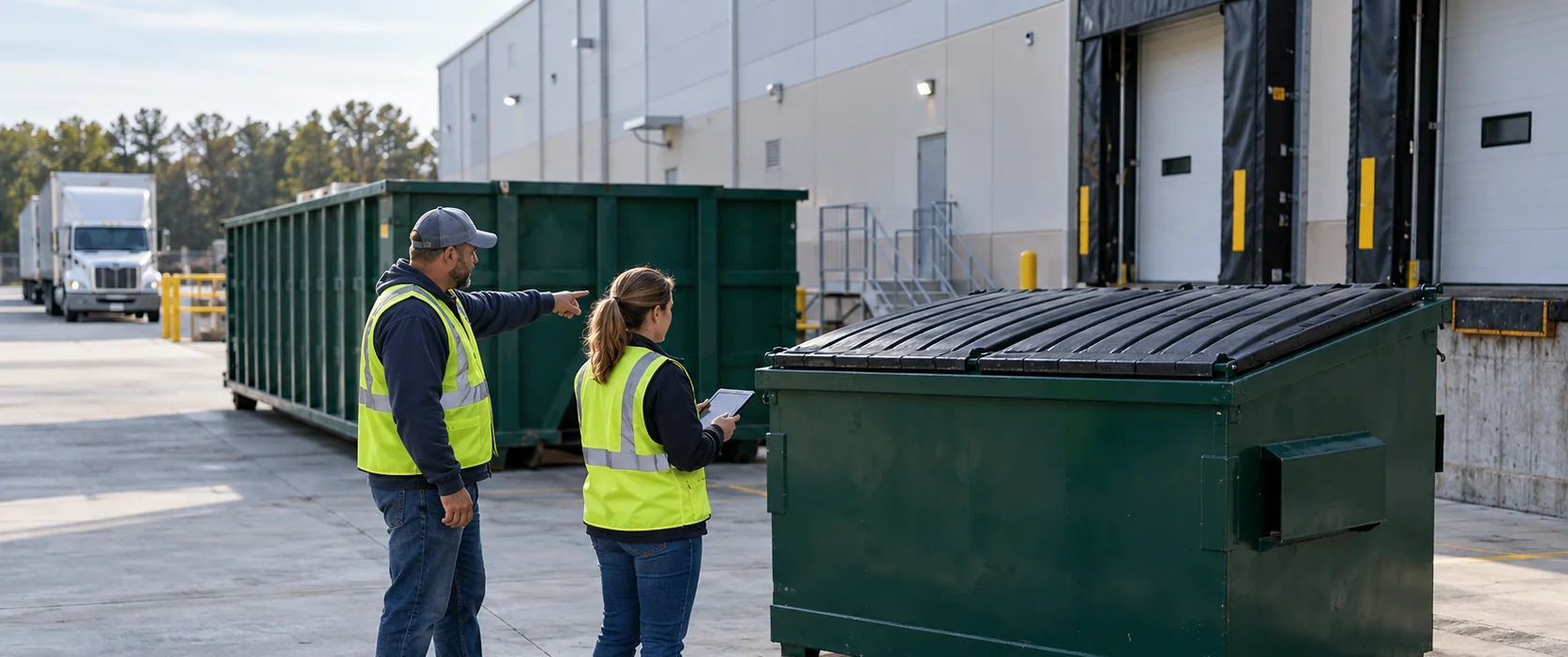
TL;DR: Size your waste container for the material that accumulates between pickups, including busy periods. Check weight limits and truck access separately. Compare a larger container with more frequent service using complete quotes, then review actual fullness and extra charges.
A waste container with its lid propped open and bags beside it gives your facility team another job before the day starts. But paying for a mostly empty container is a problem, too.
This guide helps facility managers, plant managers, and procurement teams choose capacity that fits their operation. You will learn how to measure waste, compare container options, check site requirements, and balance pickup frequency against the full service cost.
What Waste Container Sizes Are Available?
Commercial container capacity is commonly expressed in cubic yards, a measure of volume. One cubic yard equals 27 cubic feet. That tells you how much space the container holds; it does not establish its permitted load weight or its exact external dimensions.
Front-load containers generally serve recurring commercial collection. Roll-offs are often used for larger cleanouts or project waste, although some facilities use them on an ongoing basis. Waste Harmonics Keter lists front-load, roll-off, and other container services, including front-load sizes from 2 to 8 cubic yards.
Use the following sizes as a starting point for discussion, rather than a recommendation based solely on business type. The same-sized facility can generate very different loads depending on packaging, production, occupancy, and recycling.
| Container Type and Size | Potential Application | Selection Check |
|---|---|---|
| 2-Yard Front-Load | Lower-volume recurring waste streams. | Verify capacity through the longest interval between pickups. |
| 4-Yard Front-Load | Moderate recurring waste where a smaller container fills too quickly. | Compare actual fullness, frequency, and placement space. |
| 6- or 8-Yard Front-Load | Higher-volume recurring waste or bulky lightweight materials. | Confirm loading height, truck clearance, and permitted weight. |
| 10- or 20-Yard Roll-Off | Smaller project loads or cleanouts; a lower-sided option may aid loading. | Match materials and weight limits to the specific container. |
| 30- or 40-Yard Roll-Off | Larger-volume cleanouts or sustained bulky project debris. | Confirm footprint, exchanges, and whether density limits usable capacity. |
Confirm locally available sizes and request the actual equipment dimensions. Do not use a larger open-top container as permission to accept heavier debris or mix restricted materials.
How Much Waste Does Your Facility Generate?
Measure Waste Between Collections
For several representative collection cycles, record fullness immediately before pickup, the days since the last completed service, and any material left outside. Use consistent photos or a simple fullness log. Keep ordinary waste and recycling observations separate.
For example, a 6-yard container that is about three-quarters full after three days holds roughly 4.5 cubic yards of material. That suggests an average of 1.5 cubic yards per day over that observed interval. This is a planning estimate, not a measured weight or a final equipment recommendation.
Weekly capacity alone can hide a problem. Two pickups spaced unevenly leave different accumulation windows. Size around the longest gap and the busiest interval, then ask the provider to assess a practical operating margin.
Account for Busy Periods
Check receiving days, production changes, seasonal demand, events, and occupancy. A quiet week may understate the requirement; a one-time cleanout may overstate everyday needs. Record unusual loads separately so procurement can compare permanent service with temporary additional capacity.
Separate Volume From Weight
Loose cardboard can fill a container while weighing relatively little. Dense debris can reach a load limit with space remaining. The EPA’s volume-to-weight conversion factors provide material-specific estimates, reinforcing why a single conversion should not be applied to every waste stream. Use actual scale records where available and confirm the hauler’s limits.
How Does Your Waste Type Affect Container Size?
- General commercial waste: Review the mixture of bagged refuse, packaging, and other accepted material. Keep prohibited items out even when there is spare capacity.
- Cardboard and recyclables: Bulky packaging may consume space rapidly. Flattening accepted cardboard and separating recoverable material can change the capacity needed for ordinary trash.
- Food and wet waste: Consider weight, leakage, odor, cleaning, and collection timing alongside volume. Confirm suitable equipment and applicable local handling requirements.
- Heavy project debris: Concrete, masonry, and similar materials may need a dedicated container with specific loading limits. Ask for material-specific instructions before filling it.
Container sizing should follow your separation plan. Adding recycling can reduce trash volume, but it also creates a separate capacity and service requirement. Measure both streams after the change rather than assuming a fixed reduction.
Should You Choose a Larger Container or More Pickups?
A larger container can provide room for bulky loads and longer intervals. More frequent pickups can help where space is restricted or waste cannot remain onsite as long. Neither option resolves every weight, access, or material-handling issue.
Think of carrying groceries: a larger bag helps bulky cereal boxes fit, but it does not make a bag full of canned goods easier to carry. Container volume and permitted weight are separate decisions, just as bag size and lifting capacity are.
Ask for two quotes using the same material assumptions: a larger container with the proposed schedule, and a smaller container with more frequent service. Compare the longest accumulation period, access requirements, included weight, and exception charges.
Across several locations, managed waste and recycling services can coordinate those decisions with haulers and consolidate service information. Standardize how sites measure demand; allow equipment and frequency to reflect each site’s conditions.
Will the Waste Container Fit Your Site?
Container Footprint and Placement
Measure the usable enclosure or pad, gate opening, door swing, and loading position. Check surface suitability and drainage with the provider. A container that fits inside the enclosure may still be difficult for staff to load or for the collection vehicle to reach.
Truck Access and Collection Clearance
Request the provider’s vehicle-specific requirements for approach, turning, lift clearance, and container movement. Share photos and measurements of overhead lines, canopies, gates, and parked-vehicle conflicts. Avoid relying on a generic clearance number for every truck.
Safe Access for Employees
Keep pedestrian routes and emergency access clear. OSHA’s exit-route standard, 29 CFR 1910.37(a)(3), requires exit routes to remain unobstructed, including by temporarily placed materials or equipment. Extra bags beside an undersized container must not become an improvised storage area in an exit route.
What Affects Your Total Waste Container Cost?
Compare the complete service arrangement, not just the quoted container rate. Prices vary with location, materials, equipment, and contract terms, so a universal monthly price would be misleading.
- Capacity and frequency: Record the container size, scheduled collections, and whether additional visits are included or charged separately.
- Weight and disposal: Check included weight, disposal charges, material restrictions, and the method used to calculate overages.
- Rental and changes: For temporary service, confirm delivery, rental duration, exchanges, removal, and extension terms.
- Service exceptions: Ask about blocked access, overfilled containers, waiting time, cancellation, and unsuccessful collection attempts.
The awkward budget conversation starts when procurement asks why waste costs rose and the site manager explains that the base price excluded the extra pickups everyone now depends on. Log those exceptions so the next quote reflects the operation you actually run.
Paying for unused capacity is wasteful. So is squeezing the operation into a setup that repeatedly needs emergency service and staff cleanup. Compare the premium for a more suitable arrangement with the documented cost of overflow, extra collections, and time spent managing them.
How Can You Tell Your Container Is the Wrong Size?
- Repeated overflow: Material regularly reaches the fill limit before the next scheduled collection.
- Unused capacity: The container remains substantially empty before completed pickups across representative cycles.
- Extra collections: Unscheduled service has become routine rather than an occasional response to unusual demand.
- Weight-limit problems: Loads trigger restrictions or charges despite remaining space.
- Waste beside the container: Staff use surrounding areas because loading space or capacity is inadequate.
Check service completion before changing size. An overflowing container after a missed pickup may indicate a reliability problem. Poor flattening, unauthorized dumping, or a changed waste stream may also explain the symptoms. Diagnose the cause before committing to different equipment.
What Should You Ask a Waste Container Provider?
- Equipment: Which sizes suit this material, and what are the actual dimensions, loading height, and approved fill level?
- Weight and acceptance: What materials are permitted, what load limits apply, and which items need separate handling?
- Collection: What schedule is available, what truck access is required, and how are missed pickups resolved?
- Pricing: What is included, what creates an additional charge, and who authorizes service changes?
- Review: Can the provider use fullness observations, completed-service records, and invoices to reassess capacity after implementation?
How Waste Harmonics Keter Helps Size Waste Containers
Waste Harmonics Keter’s published approach begins with reviewing sites, equipment, schedules, haulers, and spend. Its program optimization service uses container fill-level and service data to adjust equipment capacity and haul frequency, with monitoring options for front-load containers and compactors.
For facility teams, that supports a decision based on observed demand instead of an inherited schedule. The assessment can connect container selection to collection timing, vendor coordination, and consolidated cost reporting. Confirm the equipment, monitoring setup, and local service scope available for your facility.
Evaluate the result using measures you can check: pre-pickup fullness, overflow incidents, extra collections, completed pickups, and total service cost. Review these after occupancy, production, or recycling changes. A successful setup should remain appropriate as the operation changes; savings should be demonstrated in records rather than assumed.
Choose a Waste Container Around Your Operation
The right waste container is the one that holds your accepted material between reliable collections, stays within weight limits, and fits the site’s loading and access requirements. Capacity, service frequency, and cost need to be evaluated together.
Before requesting a recommendation from Waste Harmonics Keter, gather representative fullness observations, waste types, current pickup schedules, invoices, and site photos. Those details make the sizing discussion more useful and the resulting quote easier to assess.
Frequently Asked Questions
What Size Waste Container Does a Small Facility Need?
Floor area or employee count alone cannot determine the size. Measure the accepted waste accumulating between pickups, including busy periods, and check material weight and available space. A provider can then compare smaller containers with the collection frequency required.
Is a Larger Waste Container Always More Cost-Effective?
No. It may reduce extra pickups, but unused capacity, access constraints, or weight limits can offset the benefit. Compare complete quotes for container size and frequency, then check actual service performance.
Can a Waste Container Be Too Heavy Before It Is Full?
Yes. Dense materials can reach the permitted load weight before using all available volume. Confirm the material-specific loading limit and appropriate equipment with the provider; do not use empty space as the only loading guide.
When Should You Change Your Waste Container Size?
Review sizing after recurring overflow, repeated extra collections, consistently unused capacity, or a change in operations. First check missed service, waste separation, and loading practices so you address the cause rather than only the visible symptom.