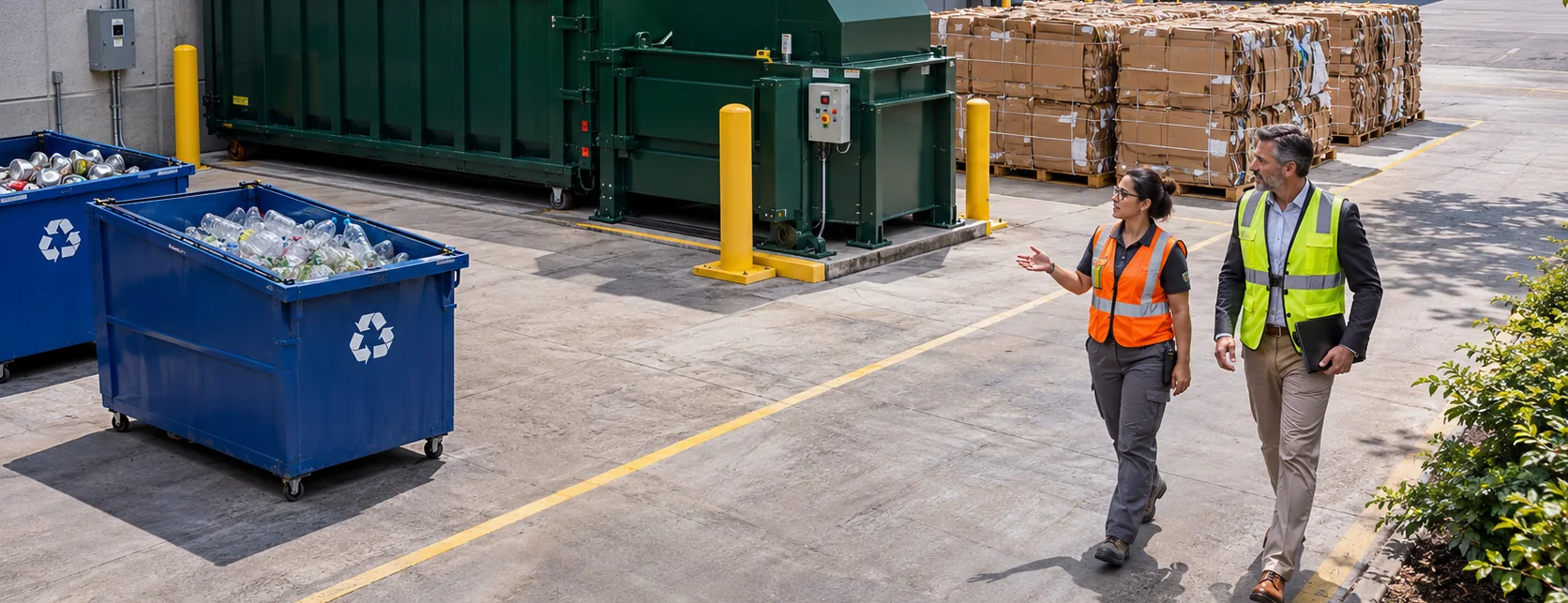
One site's audit finds 30 percent recoverable cardboard in the general waste stream. Another site's audit, run a different week with a different crew counting differently, finds 10 percent. Nobody can tell if that's a real difference or a measurement one.
For an operations or sustainability leader running an audit across several locations, the goal usually isn't just “what's in the waste.” It's a dataset that can be compared, site to site, to decide where to act first.
What a Single-Site Audit Usually Gets Right
At one location, a waste audit is relatively forgiving. The EPA's own guidance on conducting waste assessments describes the core method plainly as a combination of records review, facility observation and physical waste sorting to identify what a site generates and where reduction efforts would be most effective. Run once, with one crew, on one site, that method produces a usable snapshot.
The weak point only shows up once a second site gets audited, and a third, each using a slightly different version of the same general idea.
What Breaks When the Same Method Runs at Different Sites
A few specific things tend to drift between sites even when everyone believes they're following the same process.
- Sample timing. One site audited during a slow week and another during a peak week will show different composition even if nothing structural has changed.
- Sample size. Sorting one container versus sorting a representative share of a week's volume produces very different confidence in the result.
- Category definitions. What counts as contamination, or as recoverable cardboard versus mixed paper, needs to mean the same thing at every site, not whatever the crew on hand that day decides.
- Who's doing the sorting. A trained auditor and a site employee pulled in for the day will categorize the same material differently without meaning to.
None of these are complicated to fix individually. The problem is that without a written standard, each site solves them slightly differently by default.
What a Standardized Multi-Site Audit Actually Requires
The fix is a documented protocol applied the same way everywhere, not a stricter version of any one site's method.
| Element | What It Standardizes |
|---|---|
| Written sampling protocol | Same sample size, same timing window relative to pickup schedule, at every site |
| Shared category definitions | One glossary of what counts as contamination, recoverable material, and general waste, used by every crew |
| Trained auditors | Consistent judgment calls on ambiguous material, rather than site-by-site guesswork |
| Centralized data collection | Results recorded in one format so sites can actually be compared side by side |
Larimer County's waste diversion guidance makes a related point for the reporting side of this problem. Where waste is shared between businesses or self-hauled, invoices alone don't capture it, and a physical waste audit is needed to measure that volume directly. The same logic applies across a portfolio. Centralized invoices tell you spend, but only a standardized audit tells you what's actually in the stream at each site, in numbers you can set side by side.
Sequencing an Audit Across a Growing Portfolio
Auditing every site at once is rarely practical, so sequencing matters almost as much as method.
- Start with the highest-volume or highest-cost sites. The sites spending the most are where a composition problem costs the most to leave unmeasured.
- Audit a representative sample first, not every site immediately. A handful of sites run well establishes whether the protocol itself needs adjusting before it's rolled out everywhere.
- Re-audit on a fixed cycle, not an ad hoc one. An annual or contract-cycle re-audit catches drift before it compounds across dozens of sites.
- Flag any site whose numbers look like an outlier. An outlier result is often a measurement problem at that site, not a real anomaly, and is worth checking before it's reported as fact.
What to Require From Any Audit Process
Whether the audit runs in-house or through an outside provider, a few concrete requirements separate a usable multi-site dataset from twenty disconnected snapshots.
- A written protocol before the first site is audited. Sample size, timing window and category definitions should exist on paper before anyone starts sorting, not get decided site by site.
- One shared glossary of categories. Ask to see the actual definitions used for contamination and recoverable material, not just an assurance that every crew uses the same categories.
- A named standard for sample size and timing. Confirm what share of a site's volume gets sorted and during which week relative to the pickup schedule, since both drive how comparable the result is.
- Centralized reporting in one format. Results should land in a single system that lets any two sites be compared side by side, not separate spreadsheets or files per location.
- A documented re-audit cycle. Ask when the next audit is scheduled and what would trigger one earlier, rather than leaving the next audit undated.
Where Waste Harmonics Keter Standardizes the Protocol
Waste Harmonics Keter runs on-site waste composition analysis as part of recycling and diversion, using the same sampling and category approach across every site in a portfolio rather than leaving method to whoever happens to run it locally.
Results from that process flow into reporting, which is what actually makes a multi-site comparison possible, with one format and one set of category definitions across every location audited. For a look at what a single-site audit itself finds and why it pays off, see our piece on what a waste audit reveals, useful background before scaling the process across a portfolio.
Comparable Numbers Beat a Bigger Sample
A waste stream audit across multiple sites isn't won by sorting more waste. It's won by sorting it the same way everywhere, with the same definitions and the same sample standard, so the resulting numbers actually mean something when placed side by side. Standardize the method before scaling the audit, not after.
Frequently Asked Questions
How is a multi-site audit different from a single-site one?
The physical sorting process is similar. The difference is the need for a written, shared protocol covering sample size, timing, category definitions and auditor training, applied identically at every location. Without that standard, each site's results reflect its own measurement approach as much as its actual waste composition, making site-to-site comparison unreliable.
How often should a multi-site portfolio be re-audited?
Most programs re-audit on an annual basis or tied to a contract renewal cycle, with a fresh audit triggered sooner by a major change, such as a new site added, a new waste stream, or a result that no longer matches ongoing records data. A fixed cycle catches measurement and operational drift before it compounds across many sites.
Can invoices substitute for a physical waste audit?
No. Invoices show spend and weight by hauler, not what's actually in the stream. Where waste is shared between tenants or partially self-hauled, invoices may not even capture full volume. A physical audit is the only way to see composition and contamination directly, which is what a cost or diversion decision usually needs.
Should an internal team or an outside provider run it?
Either can work if the protocol is written down and applied consistently. The practical risk with an internal team spread across many sites is inconsistent application, with different people making different judgment calls, unless they're trained against the same shared standard. An outside provider running the same crew or protocol across every site removes that variable.